Showing posts with label Politics. Show all posts

Monday, February 12, 2018

COULD THE DENGVAXIA TRAGEDY HAVE BEEN AVOIDED?:

What might have been had Noynoy Aquino been Impeached in 2015.


Back in 2015, nobody knew of the human drama and tragedy that was about to unfold involving some 800,000 school children and their families and of the waste of some 3.5 Billion pesos worth of taxpayer’s money.  I am of course, referring to the Dengvaxia controversy.

anti-dengue%20vaccine

(Source:  CNN Philippines)


Well documented are the meetings President Aquino and his Cabinet secretaries had with Sanofi, makers of the vaccine.  It is also clear as day that regardless of the merits of the Dengvaxia vaccine, its procurement was railroaded and implemented in record time.  The whole purchase reeks of irregularity and of an administration drunk with impunity.


The timeline for this purchase was around November 2014, when the first meeting between President Aquino and Sanofi executives took place in China. Within the year, Sanofi arranged to have the drug included in the Philippine National Formulary even if it had not undergone sufficient testing.  Then, in a blitz on December 2015, Aquino and DOH Secretary Janette Garin met with Sanofi official, submitted a proposal to the DBM for its purchase and licensed the drug as a Dengue Vaccine for “all types of Individuals from 9-45 years old living in high-risk areas.”


It is simply chilling and mind-boggling to learn that this tragedy was very nearly avoided.


We recall back in July of 2014, there was a move to impeach then President Noynoy Aquino over the Disbursement Allocation Plan (DAP) controversy.  Three complaints, one filed by Oliver Lozano, another filed by Buboy Syjuco and another filed by Neri Colmenares.  The impeachment complaint was unsurprisingly thrown out in September of that year by the highly sympathetic House of Representatives.  Had the impeachment succeeded in gaining traction, the impeachment may very well have prevented the tragedy that was to become Dengvaxia.  Worse may have been that the failure of the impeachment may have further emboldened Aquino, who, unsurprisingly, used the same DAP playbook in raising the funds for Dengvaxia.

(A news report from that time)

Some have argued that the same would have been a waste of time, as it was already the twilight of Benigno Aquino III’s administration.  We could weather whatever incompetence and “Noynoying” that was about to come right?  Political stability was the more important concern back then.


Let us mull the irony of this argument for a moment.


Of course, one shouldn’t impeach an official on the basis of preventing something he/she might do just as much as one shouldn’t withhold impeachment on the argument that his/her term is about to end.  We punish an official on the basis of what he/she has done and not on the basis of damage potential.


To Impeach or not to Impeach

The takeaway is this:  It is never too late in the day to impeach an official.  Once that person has committed an impeachable offense, it is time to let him go, regardless of the damage he might or might not do.


Sunday, May 7, 2017

WILL DEMOCRACY LEAD TO DEVELOPMENT IN THE PHILIPPINES?

[Note: This is an essay I wrote for university around 2009 or 2010. This would explain the ancient sources. Nevertheless, I believe that the topic this deals with is timeless and that a resolution has not yet been achieved, and so, this is my take. I have edited this for clarity and grammar, and to address points which my professor wrote in the margins of the paper.]

The question of whether democracy leads to development or is it development that lead to democracy? Is a very contentious issue in development studies? Furthermore, given the direction of said causality. How will is this apply to Philippines government policy.

In order to better understand the whether democracy brings development or vice versa, I surveyed some studies and hoped to draw a definitive conclusion to the question of causality. However the results of this review of literature were inconclusive because of the great variation in the methods and results of development literature. It seems that the assertion that economic growth will lead to political development, and the reverse, that democratization will lead to economic growth are equally valid in light of empirical testing.

In recent years however, it seems tat the idea that democracy comes before development has become more dominant than the reverse especially now that the theory that authoritarianism is more conducive to democracy has been debunked.[1] However, I find it hard to ignore the Lipset Hypothesis—that Democratic countries can only exist at a certain level of development—because of its inherent “reasonableness,” and the fact that it is an empirical regularity.[2]

I believe, as former South Korean President Kim Dae-Jung suggests, that economic growth and democratization are “Two Wheels of a Cart,” referring to the fact that both mutually support each other, [3] and in the case of the Philippines, both development and democratization must be pursued together and not at the other’s expense.

Review of Literature

The first thing one needs to understand is what is meant by the words “democracy” and “development.” Democracy can be defined in the minimalist sense—by the mere presence of elections; or leaning towards a more liberal democratic type. In fact, Larry Diamond provides a list of the kinds of government according to the degree of democracy or freedom, namely in descending order of democratization: (1) Liberal-accountable; (2) Liberal-(partially) irresponsible; (3) Semi-liberal and; (5) Pseudodemocracies.[4] There is also the Gastill Index or more commonly known as the Index of Freedom from freedom house.[5] Development, on the other hand, would refer to economic development, as in a rise in income for members of society followed by a noticeable improvement in living standards. It could be argued, however, that the development that occurs should also be of a sustainable and holistic type.

Literature that focuses on the question of the causality between democracy and development usually takes the nature of Longitudinal and Cross-sectional analyses of countries. In other words, a set of countries is chosen and amongst themselves and try to quantitatively correlate the countries’ level of development (using development indices) with political system they have. The same system is used to test if development leads to democracy or vice versa.[6] Using the same type of studies, research yields differing results. Vanhanen surveyed several studies that seem to confirm the hypothesis that development promotes democracy. Alesina and Perotti seem to have come to the same conclusion with their survey of literature. In their survey, they have studies that seem to say that democracy more often than not has a positive effect on the economic development of a country although there are studies that show a negative correlation to growth.[7]

Gerring, Bond and Brandt criticized existing studies on the direction of the causality because existing literature “rests on a set of econometric findings in which democracy is treated as a more or less immediate cause.”[8] The problem with this is that current literature neglects the importance of a country’s history in the success or failure of its democracy in bringing development.[9] The finding of their study is that democracy has a positive relationship when taken as a stock variable and not as a contemporary variable. One implication of this study therefore is the fact that the relationship between democracy and economic growth is of a non-linear nature.

In the context of this essay these literature points to three things: First, one can now see that democracy and development are not nominal terms, they have nuances, the Philippines for example is considered by most people as democratic, however, according to Larry Diamond’s categorization, the Philippines is only in the “semi-liberal” scale; secondly, one can see that development does not promote democracy and democracy does not promote development; and third, that the relationship between democracy and development is non linear (and the reverse as well, by implication) and that the fairer methodology would be to conduct country case studies.

Which Comes First?

It is either that development is conducive to democratization because of the Lipset Hypothesis that states that when people have achieved a certain level of economic and physical security will they start participating in political activity; or that democratization is conducive to development since it promotes civil and economic liberties and “human development.”[10] Thus, once can see that democracy does not contribute to growth directly, rather, it targets the source of development which is the people. Ultimately, it is in seeking both democracy and development simultaneously that one gets both.

Another argument that democracy and development should go together is the fact that survival rates of democracies increase as national incomes rise, this has been empirically proven. For example, when per capita income (in Purchasing Power Parity or PPP) is at $1,000, the democracy is expected to last about eight years. Between $2,001and $3,000, life expectancy is 26 years. Above $6,000 democracy is “immortal.”[11] Distribution of income is also very important in a democracy for the equity of distribution will affect how fast the economy grows.[12] Definitely, a democracy would need to find ways to make money or redistribute wealth efficient and equitably if it is too survive.

This may lead one to the idea that democracy promotes development indirectly: Democracy promotes development by enhancing social participation and by promoting an environment of freedom. Democracy is a system that promotes social justice, as seen in the powerful assertion of Amartya Sen that famines do not occur in true democracies.[13] Thus, a democracy ideally should allow its citizens freedom to participate in the market, as well as freedom from want of basic goods and insecurity, all of which are conducive to growth.

There is also the theory that states that when a country changes its political system after a long period of authoritarianism, there will be growth that occurs thanks to wealth redistribution and a freer and less corrupt business environment that will likely promote foreign investment in the country.[14] To an extent, this is in line with the idea guiding the Asian Development Bank’s Doing Business Indicators which study government regulations that affect how business will work in a certain country.[15]

So it seems that democracy and development support each other mutually, or like the proverbial “two wheels of a cart.” In fact, democracy and development will become more sustainable theoretically, if policies promoting both are simultaneously pursued.[16]

Development and Democracy in the Philippines

It seems that what the Philippines lacks is democracy. More specifically, this would mean that the feature of a liberal democracy, “good governance” can be improved. What governance means, in this case, pertains no only to the government, but entails the bringing together of different sectors (government, civil society, business sector, etc.) in order to achieve certain goals or development in this context. It is in this context that improving governance would necessarily include improving Philippine standing on the democracy scales.

According to the 2005 Asian Development Bank (ADB) Report on the Philippines, good governance would entail improving on the (1) accountability of officials; (2) participation of other sectors; (3) Predictability especially in the implementation of laws and (4) transparency of government.[17] Improving accountability and transparency is believed to reduce corruption and thereby improving the investment climate.[18] Participation is said to mitigate the “agency problem” or the inability of governments to implement their policies.[19] Predictability applies more specifically to the consistent application of laws. This is said to lower risks for businessmen since it makes the business atmosphere more “calculable” which is a prerequisite to taking risks.[20] Currently, politics and business in the Philippines are characterized by a lack of these basic elements of good governance. There is not much accountability as seen in the rampant corruption in the Philippines, corruption so blatant and widespread, this needs no citation. Participation from other sectors of society also seems weak as there are not many constitutional means to affect public policy—that Filipinos would often take to the streets to be heard is hardly a desirable means of participation; the barriers of getting an elective position are also prohibitively high; and that appointment to public office depends more on who a person knows than what he knows. Transparency of government is not upheld to the level that it should, as the number of journalists “killed” attests to this. Far from being predictable in terms of the consistency of the law’s application, the general sentiment appears that laws are being applied arbitrarily in the Philippines—that the law will be applied according to the ability to pay. More importantly, this “arbitrariness” is not conducive to business, a sector which would much rather prefer a “calculable” legal environment, thus hurting the country’s ability to develop capital and productive capacity, ultimately hurting the country’s ability to develop economically.[21] There are many more defects of Philippine governance worth noting, however, these four areas should already make enough of a case to say that the government should try to go higher up in the freedom scales.

In order to develop Philippine governance, particularly in the area of “participation,” the Philippines would have to raise a lot of its people from poverty—these people would have to be given the necessary material security in order for the Lipset Hypothesis to take place, thus, at least in the area of mass participation in governance, will development necessarily have to precede democratization. This has to be done while at the same time promoting democratization in other areas of government.

Conclusion

What the Philippines needs is neither development nor democracy alone, but both together. Government has to do its part to uplift the lives of its citizens in order to get them to participate in governance. The country needs good governance in order to make the country more “democratic” and thus presenting a better atmosphere for business. However, in order to uplift the lives of its poorer citizens, what is needed is a liberal democratic government as it intrinsically cares about enhancing opportunities for its citizens.

Thus, one can see that both development and democracy are mutually supporting. The development outcomes would also be much more sustainable and equitable if both development and democratization programs are applied, or more concretely, pursue democratization with a focus on where is counts for the most, in the business sectors.


[1] Halperin, M., J. Siegle & Weinstein. The Democracy Advantage: How Democracies Promote Prosperity and Peace. (New York: Routledge, 2005), p. 9.

[2] Barro, R. Determinants of Democracy. (Harvard University). P. 21.

[3] Dae-Jung, K. “Democracy and the Market Economy: Two Wheels of a Cart.” Democracy, Market Economics and Development: An Asian Perspective (Washington DC: World Bank, 2001). P. 1.

[4] Diamond, L. “Moving up out of poverty: What Does Democracy Have to Do With It?World Bank Workshop (Washington DC: World Bank, 2003). P. 21-22.

[5] Supra Note 2 P. 1.

[6] Vanhanen, T. Prospects of Democracy. (Routledge, 1997). P. 4.

[7] Alesina, A. & Perotti, R. “The Political Economy of Growth: A Critical Survey of Recent Literature.” The World Bank Economic Review (September, 1994). P. 353.

[8] Gerring, J., P. Bond, & W. Brandt. Democracy and Economic Growth: A Historical Perspective. (Unpublished Research Paper, 2004). P. 4.

[9] Ibid. P. 2.

[10] Supra Note 7 P. 354

[11] Pei, M. “Political Institutions, Democracy and Development.” Democracy, Market Economics and Development: An Asian Perspective (Washington DC: World Bank, 2001). P. 27.

[12] Supra Note 7 P. 364

[13] Sen, A. “Democracy and Social Justice” Democracy, Market Economics and Development: An Asian Perspective (Washington DC: World Bank, 2001). P. 13.
In his argument, Sen cited the example of India as not having suffered a famine since it gained its independence.

[14] Supra note 2, Abstract

[15] World Bank. Doing Business 2008: Philippines (Washington DC: World Bank) P. 1.

[16] Supra note 3

[17] Asian Development Bank. ADB Country Governance Assessment: Philippines. (Asian Development Bank, 2005) p 2.

[18] Iqbal, F & J. Il-You. Democracy, Market Economics and Development: An Asian Perspective Ibid. p 35.

[19] Ibid P. XIII

[20] Hutchcroft, P. Booty Capitalis,: The Politics of Banking in the Philippines (Ithaca NY: Cornell University Press, 1988). P 32-33.

[21] Ibid. p. 35

Saturday, November 19, 2016

THE BOOGEYMAN IS FINALLY BURIED


I woke up this morning and I felt strangely refreshed.  It felt as though a huge weight had been lifted off of my shoulders.  As you know, the family of Former President Ferdinand E. Marcos buried him yesterday morning in a discreet and intimate burial in the Libingan ng mga Bayani (LNMB).  For the past 30 or so years after his death, Marcos had been kept in a refrigerated casket for all the world to see, his corpse was gawked at or venerated and defiled.  His mortal remains were used as a symbol by loyalists and pro-Aquino alike, sowing division.  It is because of this that President Duterte once and for all decided to put the issue and his mortal remains to rest.  Make no mistake about it, this was a political decision calculated to end division between the loyalists and the pro-Aquino—this does not change the past, but sets a course for our future unburdened by Boogeymen and infighting.


I am glad he is buried now and out of sight.  Like Mark Anthony speaking at Caesar’s funeral in Shakespeare’s play, I would simply like to say that “I have come to bury Marcos, not to praise him.  The evil that men do lives after them; the good is oft interred with their bones…”  And so it is with Marcos.  I hope you do not think that simply because he has been buried, his sins are buried with him.


julius_caesar

“The evil that men do lives after them; the good is oft interred with their bones”

Now that he has been buried, I believe that this country can now really and truly move forward.  While his corpse was above ground, he was the Boogeyman—a legendary monster, a story to spook children from misbehaving.  During the second Aquino administration, it seemed like a running joke to talk about the ills of Martial Law all the while abuses and mismanagement continued.  Our history should never be used to cover up or justify present abuse.  Neither does it justify partisanship when all camps are guilty of mismanagement and abuse.  I sincerely hope that supporters of both sides open their eyes and see things who what it is, both the loyalist camp and the pro-Aquino camp used your hatreds for political ends and took you all for a ride. 


For the victims, nothing can replace what you have lost and what you have endured.  The government has recognized this as a turbulent time in our history.  Evil heathen forces carrying Mao Zedong’s ideas and Lenin’s hammer and sickle banner were at our gates.  Marcos chose to fight fire with fire.  The jury is still out on this.  History far removed from partisanship will judge him, as God surely has already.  Today Marcos is buried and worms tear at his flesh, yet the very architects of the Martial Law regime, Juan Ponce Enrile and Former President Fidel Ramos live and enjoy a pride of place in our government.  Victims, you will get more answers and closure from the living than with the dead.


Nor do I feel like we have “violated” our history in having him buried there.  As  I said, the jury is still out on this one.  Some groups insist that we as a people are suffering collective amnesia for allowing this, but I say that we are  suffering collective amnesia about those days when Martial Law was declared.  Why was Martial Law declared?  Was it the sensible thing to do at the time?  Was it really the ultimate evil that some groups would have us  believe?  Did we benefit from Martial Law?  The jury is still out on all of these questions.  Hopefully, history will decide with impartiality. 


Let us be clear here.  This was not a “hero’s burial.”  This was a plain and simple burial.  Some groups insist that what was done was a hero’s burial.  Well, if they insist.  As earlier mentioned, when a man is buried, the evil he has done lives after him, and the good is often interred with his bones, but this is not strictly correct, Marcos’s legacy spans the full spectrum of very good to the very bad.  We knew he was after the common good, and legislation in the 1970s-80s demonstrated very forward and enlightened thinking.  Contemporary Congresses are hard pressed to match his legal corpus with laws on Muslim family relations, laws on child and youth welfare, laws on labor, laws on overseas workers, laws on land reform, laws on criminal law spanning crimes, penology and procedure, commercial laws on corporations, insurance, still in active use today! Government agencies and corporations were also created to match his vision for the country.  His legacy is not only in the realm of ideas, but also infrastructure, especially in far flung areas, and the modern demography of Mindanao owes it to Marcos’ decision to promote Mindanao as an area for lowland Filipinos to settle in.  Though, I have to admit, this has had grave consequences for the Muslims and indigenous peoples living there, leading to continuous war and strife in the region.  He has made decisions good and bad, he has made contributions both good and bad—these are a given because of his office and title, as even the most enlightened of statesmen would be forced to make difficult decisions.  Marcos was a President of this country, the hard decisions were his to make and only history can judge him now.  

the boogeyman

President, Pure Evil or “Boogeyman,” history removed from partisanship

will decide in its own good time


If there is anything I want justice for, it would be for the ill-gotten wealth.  With this burial, I hope the Presidential Commission on Good Governance (PCGG) will find renewed drive and vigor to recover the ill-gotten wealth.  Please take heart, all is not lost, as Imee Marcos has admitted, the cases for this ill-gotten wealth remain pending with the courts, so please see these cases through. 


In the meantime, the country must move on, and move on we will, less one Boogeyman and less one corpse defiled and used by supporters and detractors alike.

Thursday, November 10, 2016

RANT: LIBERALS ALL OVER THE WORLD HAVE TO REASSES THE SITUATION AND REEVALUATE THEMSELVES AND THEIR PRIORITIES


I am really tempted to gloat.  I dislike liberals of the American and even the Filipino variety, and it seems that 2016 is the year that their world fell apart for them.  Indeed, my Facebook feed is filled with their whining and gnashing of teeth.  But gloating is cruel and doing so tends to reduce the righteousness of one’s cause.  It is better to look and examine what happened?  Why did the Duterte and Trump victories catch them off guard, why did their efforts to discredit both of these people and their supporters fail?  It is too simplistic to call the supporters of these populist, firebrand politicians as bobo, retard or idiotic sheep.  Neither is it wrong to say that the liberal “cause” is wrong or unpopular—No, I think the problem is in the liberals themselves, and they should take the time to reflect, reassess and reevaluate themselves and their position.

358qda
The state of social media right now. 

How would I characterize a “liberal?”  I use this term loosely because “liberal” can mean many different things depending on context.  Generally speaking, I refer to this as a “political philosophy based on belief in progress, the essential goodness of the human race, and the autonomy of the individual and standing for the protection of political and civil liberties”  (Merriam-Webster Dictionary).  In the United States, these are usually adherents of the Democrat party.  In the Philippines, they are closely linked with the Liberal party.  In fairness to the Liberal Party, it is the closest the Philippines has to an actual political party in the cohesive, traditional and American sense of the word.  Sadly, it seems that their cohesion is due to a figurehead—the son of two so-called “heroes” who gained prominence during the Marcos regime.  The father of this figurehead was supposedly “assassinated” by then President Marcos while his mother became President of the Philippines in a bloodless coup.  This group professes to prioritize human rights, freedom of speech, are against discrimination of any sort, decent behavior and they generally have a favorable view of America and share a lot of these same beliefs with American liberals.  To be fair, a lot of these people are genuinely decent people, its just that they are misguided by their own self-righteousness.

Liberals are self-righteous and sanctimonious
Liberals are so convinced of the righteousness of their position, they welcome no opposing views and look down if not outright humiliate a person espousing a contrary view.  Right now, I dread opening my social media.  All I can see in it, as far as the eyes can see is the incessant whining and tears of Liberal Filipinos.  Its always about the same things:  the libingan ng mga bayani, Trump, Duterte, Delima, and, heck, even the Leni Robredo “tuhod” comment.  And a lot of those concerns are irrational and ad hominem, anyone who cares to point that out gets bashed and groups of liberals would band together and support one another in a circlejerk.  They are prone to superlative, such as comparing former President Ferdinand Marcos to people like Adolf Hitler, Pol Pot and Idi Amin, you know, people who have actually committed genocide as a policy of their state.  Dare to point out that you are cheapening the experience of Holocaust survivors by comparing Hitler to Marcos and you will get a faceful of hate for interrupting the circlejerk.  American liberals are hardly any different, point out the scandals that hound Hillary Clinton and you will be accused of being a misogynist.  

They have a poor grasp of the issues and arguments
To be fair, non-liberals haven’t been the best at “marketing” their position either.  Their position is one of drastic measures—great changes in policy.  They aren’t really accustomed to voicing out their discomfort and their concerns, so they won’t be masters at convincing right away.  Liberals on the other hand, are like professional “whiners” and are accustomed to having a “feel good” stance on issues.  In a way, Liberals have never tried to get our of their comfort zone.  Ask any Liberal what they think of “rape jokes” and they will tell you that “rape jokes are bad [period].”  Ask them to explain why that is the case and 9 times out of 10, you will get crickets.   

They block out contrary opinions
Another thing liberals should learn to do is to listen to contrary opinions.  Try to see where the “other guy” is coming from.  American liberals (AKA Democrats) are seemingly more prone to shutting out contrary opinion than their conservative counterparts.  Reuters reports:

Fourteen percent of respondents in the Reuters/Ipsos poll said they had blocked a family member or close friend from social media because of the election. For Democrats, this rises to 23 percent compared to 8 percent for Republicans.

This goes to show that liberal people are more likely to shut out contrary opinions and ideas from their own.  When thinking in a movement only exists in a circlejerk, critical thinking is lost and that is when the movement loses its relevance.  What better example of this behavior than the Philippine’s own Rappler, a news website with [obvious] liberal leanings, wrote a series of articles about a “propaganda war” predominantly blaming an ordinary blogger Mocha Uson for spreading propaganda thanks to her army of bots (!) hoping to put a stop to her blog.

It is also very easy to see how the liberal coastal cities of America and their wealthy residents can seem so out of touch with the rest of their countrymen.  To them, their main concern is advancing the feminist cause, gay marriage, Hollywood, legalization of Marijuana while non-liberals/Trump supporters had very different concerns:  jobs, immigration, perceived weaknesses in America’s foreign policy.  So therefore, shutting out contrary opinion and a cocooned existence don’t do wonders for liberal PR.  It just makes one seem “elitist.”

Victim Mentality
Liberals can’t seem to comprehend the idea of blaming oneself for one’s failures—they always try to portray themselves as the victim.  In Clinton’s case, she wasn’t seen as fit for the job by many democrats resulting in very low voter turnout.  I wonder if the democrats really expected an easy victory just because she was a woman running against a misogynist?  Worse was that after Trump gave his thank you speech which he tried to fill with as much hope for the future, the most memorable (and retweeted) part of Clinton’s concession speech was something about breaking the “glass ceiling.”  Are they seriously blaming their loss on the fact that she is a woman?

Its a pity that liberals played the gender card thinking that Americans will vote for a person simply on account of her gender.  I’m glad to see that meritocracy still exists in some form over there.  The same victim mentality is rampant among the liberals of the Philippines.  Best example is Senator Leila Delima who keeps bringing up her gender in her numerous press conferences with the liberal media of the Philippines.

What’s Next?
For Filipino liberals, the events of the past year should serve as a wake-up call.  Since you abhor Trump so much, perhaps it is time that you stop placing America on a pedestal and learn to think for yourselves. 

I understand and sympathize with your convictions.  In fact they are very honorable, so please don’t give up.  Learn from your shortcomings.  I will leave you with what I saw on my Facebook feed from a person that I respect has written:

I kind of just want to remind people who are blaming democracy these days that:
A) both Trump and Duterte did not grab power. Don't you just feel grateful that elections remain to be undisrupted in both countries?
B) democracy isn't suddenly wrong because things didn't go your way
C) it's democracy that will let you get up again tomorrow and start your 4 or 6 year campaign.

...
Good night!


Please be guided accordingly!

------
Note:  Please forgive the rant.  This was hastily written so I can get this out while this historic moment remains fresh.  I talk about America and the Philippines.  The near simultaneous elections we had seems to have caused a great deal of grief for many people regardless of whom you support and whatever your values are.  Also, I am no expert in American culture and politics, hence comments, suggestions and corrections are very much welcome.

Tuesday, August 23, 2016

JALOSJOS vs. COMELEC and ERASMO


G.R. No. 191970; April 24, 2012

Ponente:  Abad

Doctrine: Proof required to establish domicile of a reinstated Filipino citizen running for governor of a province

FACTS:
Petitioner Rommel Jalosjos was born in Quezon City.  He migrated to Australia when he was eight years old and acquired Australian citizenship.  In 2008, he returned to the Philippines and lived in Zamboanga, he took an oath of allegiance to the Philippines and was issued a certificate of reacquisition of citizenship by the Bureau of Immigration and he renounced his Australian citizenship. 

Jalosjos applied for registration as a voter in Ipil, Zamboanga Sibugay, but Private Respondent Erasmo, the barangay captain, opposed the registration.  COMELEC approved the application and included Jalosjos in the voter's list.  This decision was affirmed at the MCTC and at the RTC.

Jalosjos then filed a certificate of candidacy (COC) for Governor of Zamboanga Sibugay for the 2010 elections.  Erasmo filed a petition to cancel the COC on the ground of failure to comply with the one year residency requirement of the Local Government Code (LGC).

COMELEC held that Jalosjos failed to present ample proof of a bona fide intention to establish a domicile in Ipil, Zamboanga Sibugay. It held that when he first moved back to the Philippines, he was merely a guest or transient at his brother's house in Ipil, and for this reason, he cannot claim Ipil as his domicile.  Meanwhile, Jalosjos won the elections.

ISSUE:
Whether or not the COMELEC is correct in holding that petitioner did not present ample proof of a bona fide intention to establish domicile at Ipil, Zamboanga Sibugay.

HELD:
NO.  The COMELEC is incorrect.  Jalosjos has successfully proven by his acts of renouncing his Australian citizenship and by living in Ipil, that he has changed his domicile to Zamboanga Sibugay.

The LGC requires that a gubernatorial candidate be a resident of the province for at least one year before the elections.  For the purposes of election laws, the requirement of residence is synonymous with domicile:  i.e. he must have an intention to reside in a particulaar place, but must also have personal presence coupled with conduct indicative of such intention.

The question of residence is a question of intention.  To determine compliance with the residency/domicile requirement, jurisprudence has laid down the following guidelines:

   (a)               every person has a domicile or residence somewhere;

(b)               where once established, that domicile remains until he acquires a new one; and
(c)               a person can have but one domicile at a time.

The facts show that Jalosjos' domicile of origin was Quezon city.  When he acquired Australian citizenship, Australia became his domicile by operation of law and by choice.  On the other hand, when he came to the Philippines in November 2008 to live with his brother in Zamboanga Sibugay, it is evident that Jalosjos did so with intent to change his domicile for good. He left Australia, gave up his Australian citizenship, and renounced his allegiance to that country and reacquired his old citizenship by taking an oath of allegiance to the Philippines.  By his acts, Jalosjos forfeited his legal right to live in Australia, clearly proving that he gave up his domicile there. And he has since lived nowhere else except in Ipil, Zamboanga Sibugay.

To hold that Jalosjos has not established a new domicile in Zamboanga Sibugay despite the loss of his domicile of origin (Quezon City) and his domicile of choice and by operation of law (Australia) would violate the settled maxim that a man must have a domicile or residence somewhere.


Neither can COMELEC conclude that Jalosjos did not come to settle his domicile in Ipil since he has merely been staying at his brother's house.  A candidate is not required to have a house in order to establish his residence or domicile in that place.  It is enough that he should live there even if it be in a rented house or in the house of a friend or relative.  To insist that the candidate own the house where he lives would make property a qualification for public office.  What matters is that Jalosjos has proved two things: actual physical presence in Ipil and an intention of making it his domicile.
As evidence, Jalosjos presented his next-door neighbors who testified that he was physically present in Ipil, he presented correspondence with political leaders and local and national party mates, furthermore, he is a registered voter by final judgement of the RTC.  The court also noted that Jalosjos has since acquired a lot in Ipil and a fish pond in San Isidro, Naga, Zamboanga Sibugay.  This, without a doubt is sufficient to establish his intent to set his domicile in Ipil, Zamboanga Sibugay.
DISPOSITIVE
WHEREFORE, the Court GRANTS the petition and SETS ASIDE the Resolution of the COMELEC Second Division dated February 11, 2010 and the Resolution of the COMELEC En Banc dated May 4, 2010 that disqualified petitioner Rommel Jalosjos from seeking election as Governor of Zamboanga Sibugay.

Tuesday, April 12, 2016

MARTIAL LAW AMNESIA? NOT!

This article is a response to a Philippine Star Opinion Piece Written by Crispin C. Maslog dated April 12, 2016.

An opinion piece recently appeared in the Philippine Star entitled Martial Law Amnesia written by Crispin C. Maslog.  This is a cut and dried piece basically explaining how the Marcoses abused their power during Martial Law and because of this, we should not elect Ferdinand “Bongbong” Marcos Jr., as Vice President. The article begins with an explanation as to how the Millennial generation is not to blame for “Martial law amnesia”.  Maslog explains that this is because their generation “did not teach history properly”, and then he proceeds to talk about how President Marcos wanted to increase his term, suspended the constitution and declared martial law and how everything went downhill after that et cetera, et cetera.

I am a Millennial and forgive me Mr. Maslog, but this sounds eerily like what we have been indoctrinated in in school.  This is the same history and the same discourse that is being taught to the kids today.  I will give Mr. Maslog credit though, he has come to terms with the fact that it is not the Millennial’s fault for the historical revisionism and glamorization of the Martial Law period, but this is not for want of being told stories of the “horrors” of Martial Law rule.  I’ll put it to you plainly, this is a reaction to the failures of Maslog’s generation.

Filipino Millennials
(source: Philippine Star)

Let me be blunt about this, everything that the Martial Law generation did after 1986 makes me want to puke.  What we are seeing today is a reaction to the incompetence and failure of the Martial Law generation to create a better and more prosperous Philippines after the dictator was toppled.  Newsflash! The Millennial generation has come of age.  No longer do we look up to the previous generation who, after 30 years, represents nothing but stagnation and incompetence to us.  My generation knows that what we want is a leader who has genuinely created in us a sense of hope for the future—a leader who, to us represents a future that does not involve having to choose “lesser evils”, a country that is united to achieving status and prestige. 

-o0o-

These times remind me of 2010.  There was a man, then running for President, his name was Gilbert Teodoro.  Of all the candidates then, it was only he who could give us a vision of the Philippines “taking off”.  His vision of the Philippines then was one where the Philippines had a credible military, a booming economy and self-sufficiency.  A lot of the youth could relate with this and it is not surprising that in college polls, Teodoro always came out on top.  My generation wanted this man in office.  Instead, the Martial Law generation disappointed and further disillusioned us when, riding on a wave of sympathy and nostalgia of the Cory years, voted her son into office knowing full well that he was not prepared for such a position.


He was popular with the youth, it’s just too bad that many were too young to vote in 2010

Times have changed though, in 2010, a lot of Millennials were still under 18 years old.  Many were in college or were fresh graduates—we didn’t have a say at all.  Now, the Millennials are all above 18 years old, many are independent and holding positions in middle to upper management, many are married and have children.  The Millennials are becoming increasingly aware of the political and persuasive power they hold and are more than willing to think for themselves.  On the other hand, the Martial law generation has aged, many have died, others have lost parental authority over the Millennials.  Yes, that generation has failed and disappointed us Millennials.  We all know what happened after—six wasted years.

The Millennials are becoming increasingly aware of the political and persuasive power they hold and are more than willing to think for themselves. 

The article ends stating:

The history of this economic plunder is one of the blind spots in the minds of the Filipino millennials today.  It worries me and my generation no end, that the son of Ferdinand Marcos is running for vice president of the land, and be just a heartbeat away from the presidency. If that happens, philosopher George Santayana may again be proven right when he said long ago that a people who do not remember their past are condemned to repeat it.


My generation knows this.  Our history of economic plunder continues.  It continues today with the mismanagement and cronyism of the current administration.  With all due respect to Mr. Maslog, my generation lives through this, every day when we ride the decrepit trains, pay for overpriced electricity and telecom, line up for hours at government offices, see news of starving farmers and yet another massacre, whenever we see incursions in our territory and how powerless our military is to stop it.  Make no mistake, we are repeating history, it just looks like the role of villain and hero has been reversed.


Wednesday, September 16, 2015

ARNAULT vs. BALAGTAS

Citation: G.R. No. L-6749; 97 Phil. 358; July 30, 1955
Ponente: Labrador

Topic: Legislative investigation; may Senate hold a person in contempt as a punitive measure.

FACTS:
This was a petition for habeas corpus filed by Jean Arnault against the Director of Prisons, Balagtas. Arnault was incarcerated pursuant to a resolution by the Senate finding Arnault in contempt for refusing to disclose the name of a person with whom he transacted business in relation to a government purchase of of the Buenavista and Tambobong estates. The circumstances of Arnault's incarceration are described in the companion case Arnaultvs. Nazareno (1950) which affirmed the Legislature's power to hold a person in contempt for defying or refusing to comply with an order in a legislative inquiry.

Arnault eventually divulged that he had transacted with one Jess D. Santos in relation to the Buenavista and Tambobong deal. Upon further inquiry, the Senate, obviously not satisfied with Arnault's explanations, adopted Resolution No. 114. The title of the resolution states:

RESOLUTION APPROVING THE REPORT OF THE SPECIAL COMMITTEE TO INVESTIGATE THE BUENAVISTA AND TAMBOBONG ESTATES DEAL, AND ORDERING THE DIRECTOR OF PRISON TO CONTINUE HOLDING JEAN L. ARNAULT IN HIS CUSTODY, AND IN CONFINEMENT AND DETENTION AT THE NEW BILIBID PRISON AT MUNTINLUPA, RIZAL, UNTIL THE SAID ARNAULT SHALL HAVE PURGED HIMSELF OF CONTEMPT OF THE SENATE.

x x x

WHEREAS, the Senate holds and finds that the situation of the said Jean L. Arnault has not materially changed since he was committed to prison for contempt of the Senate, and since the Supreme Court of the Philippines, in a judgment long since become final, upheld the power and authority of the Senate to hold the said Jean L. Arnault in custody, detention, and confinement, said power and authority having been held to be coercive rather than punitive, and fully justified until the said Jean L. Arnault should have given the information which he had withheld and continues contumaciously to withhold;

WHEREAS, the insolent and manifest untruthful statements made by the said Jean L. Arnault on the occasions above referred to constitute a continuing contempt of the Senate, and an added affront to its dignity and authority, such that , were they to be condoned or overlooked, the power and authority of the Senate to conduct investigations would become futile and ineffectual because they could be defied by any person of sufficient stubbornness and malice;

x x x

The Court of First Instance ruled in favor of Petitioner Arnault and ordered his release.

ISSUE:
Whether or not Petitioner may be released from his Senate-imposed incarceration.

1. Whether or not the CFI has the right to review the findings of the Senate.

2. Whether or not the Senate may hold a person in contempt or incarcerate him as a punitive rather than as a coercive measure.

HELD:
YES. The Senate may continue to keep Petitioner incarcerated.

1. NO. In the first place, the CFI did NOT have the right to review the findings of the Senate. In the above quoted resolution, the Senate in stating that petitioner “has failed and refused, and continues to fail and refuse, to reveal the person to whom he gave the amount of P440,000” and that the situation of petitioner “has not materially charged since he was committed to prison”, clearly shows that the Senate believes that Arnault was still trying to deceive them. The CFI on the other hand arrogated unto itself to review such finding and held that Arnault satisfactorily answered the questions of the Senate in its investigation of the Buenavista and Tambobong deal.

There is an inherent fundamental error in the course of action that the lower court followed. It assumed that courts have the right to review the findings of legislative bodies in the exercise of the prerogative of legislation, or interfere with their proceedings or their discretion in what is known as the legislative process. The Judicial department has no right or power or authority to do this, in the same manner that the legislative department may not invade the judicial realm in the ascertainment of truth and in the application and interpretation of the law, in what is known as the judicial process, because that would be in direct conflict with the fundamental principle of separation of powers established by the Constitution. The only instances when judicial intervention may lawfully be invoke are when there has been a violation of a constitutional inhibition, or when there has been an arbitrary exercise of the legislative discretion.

2. YES. The legislature may hold a person in contempt or incarcerate him as a punitive measure.

Although the resolution studiously avoids saying that the confinement is a punishment, but merely seeks to coerce the petitioner into telling the truth, the intention is evident that the continuation of the imprisonment ordered is in fact partly punitive. This may be inferred from the confining made in the resolution that petitioner's acts were arrogant and contumacious and constituted an affront to the Senate's dignity and authority.

The legislature has the power to punish recalcitrant witnesses. This power is founded upon reason and policy. Said power must be considered implied or incidental to the exercise of legislative power, or necessary to effectuate said power. How could a legislative body obtain the knowledge and information on which to base intended legislation if it cannot require and compel the disclosure of such knowledge and information, if it is impotent to punish a defiance of its power and authority? The legislative department should not be constrained to look to the courts whenever for every act of refusal, every act of defiance, every act of contumacy with which it is faced.

The exercise of the legislature's authority to deal with the defiant and contumacious witness should be supreme and is not subject to judicial interference, except when there is a manifest and absolute disregard of discretion and a mere exertion of arbitrary power coming within the reach of constitutional limitations.


The judgment appealed from should be, as it hereby is, reversed, and the petition for the issuance of the writ of habeas corpus denied. The order of the court allowing the petitioner to give bail is declared null and void and the petitioner is hereby ordered to be recommitted to the custody of the respondent. With cost against the petitioner-appellee.

Sunday, April 26, 2015

TURNING THE BANGSAMORO REGION INTO A POLITICO-MILITARY COMPLEX

A professor in International Relations once told me, “The first rule in international relations is, ‘take care of your own backyard first.’”* Therefore, so long as the Muslim Rebellion (and the communist rebellion by extension) exists in our own backyard, we will never look credible in the eyes of another country and we will continue to be “bullied” by savvier players like China and Malaysia.


In an earlier piece, The massacre of the  PNP-SAF as an affront to our sovereignty, I took the seemingly unpopular stand of going to war:


There must be retaliation from the government forces. The present administration is treating the MILF with kid’s gloves, giving in to demands from known terrorists. We must negotiate from a position of power: wipe-out several camps and decapitate its leadership--leave them powerless.


Now, “all-out-war” seems to be the stand that the government is taking as regards to the breakaway faction, BIFF. My hope is that the war will escalate to cover other [terrorist] groups, the Abu Sayaff, the “fallen-from-grace” MNLF, JI, ISIS and of course, the MILF. I say this because, I assert that true peace can never be had with groups like these -- you can have peace with one or maybe two, but those dissatisfied with the “Government’s peace”, will just form another breakaway faction and continue the rebellion. This is what the BIFF is doing and what the MILF did before that.


In this article, I seek to answer two very important questions that should follow the defeat of these terrorist elements:


  1. How would the fighting make the Philippines stronger in the eyes of the International Community?


  1. How to win the hearts and minds of the people one the fighting is done?

The answer should be simple, bring development and keep the peace in the area. This means, food, jobs, shelter, access to credit, electricity and all the appurtenances of a decent living.


Credibility before the international community


As I mentioned at the start of this article, nothing will bring respect in the international community more than being able to take care of the problems in your own backyard.


I will argue that after all the fighting is done, the grounds that were once MILF/BIFF and other terrorist group strongholds should be turned into military bases, research facilities, Military schools, stockpiles and if possible, new communities.


Rebel Camps and our Weakness


As we all know, Philippine military might is less than ideal. I even argued in my earlier piece that if there is no retaliation for the #fallen44, our enemies are going to take notice of our weakness. Indeed, this may be the case because the Chinese Coast Guard seems to be bullying our fishermen again and blatatly constructing facilities in our territory. This is something I believe the Chinese will not do if they think that the Filipino military is simply competent in dealing with its external and internal affairs. i.e. if we cannot deal with a bunch of bandits in our southern isles, how then can we fight against Chinese aggression? Inaction and weakness will only embolden our enemies. Indeed, I don’t see Vietnam or Malaysia having the same problems with the Chinese.

The symbol of Philippine defiance against China, and the full extent of our military capabilities


Indeed, a Country’s martial and political credibility often depend on being able to “project military strength hundreds of miles from their home bases, both internally and externally”.


Yes, I know that there is a Constitutional prohibition against war, but there are many ways around that insofar as there is a perceived threat to the territorial integrity of the country.


Bringing the blessings of peace to the Bangsamoro


In answering the question, “how to win the hearts and minds of the people”, I propose concentrating political power in the South and the conversion of the symbolic capital of the MILF, Camp Abubakar, into a fine new Capital City for the Philippines.


Is concentrating power in Mindanao a good idea? Yes, I believe so. Right now, the threat country’s biggest threat is China, which lies in the northeast, any invasion or attack would be concentrated in Manila/Luzon -- the most prosperous region in the country. But with the government holed up in Mindanao, we will still be able to mount effective and coordinated resistance. This is our Dschungelfestung where we can conserve our forces and mount a defense in-depth.


To make this work though, a lot of the work has to be done in secret, it is preferred that each camp should be a fortress of its own, with lots of underground tunnels and pillboxes which would make a direct assault foolhardy. If possible, each camp could be interconnected with one another in order to provide a network of support and intelligence.


What of Camp Abubakar?


Camp Abubakar was the MILF Headquarters and an important base of operations. It was a major prize during the government offensive.


Froilan Gallardo, back in 2010, writes:


Camp Abubakar was more than a military camp. MILF top leaders, Al Haj Murad Ebrahim and the late Salamat Hashim had their offices there. Murad, who was then MILF military chief, held office in Barangay Sarmiento, Matanog town while Salamat, the MILF chair, resided in a small bungalow inside Camp Abubakar itself.

21abubakar1web

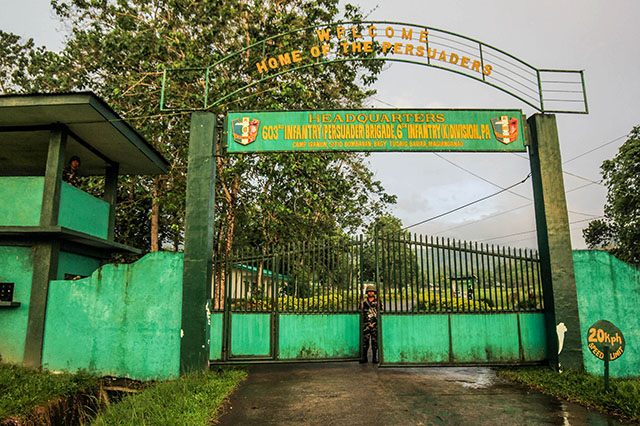
Camp Abubakar is now a Military Base


According to Joe America, an American blogger residing in the Philippines envisions a progressive Mindanao which is likened to the West Coast of the United States, versus the Luzon-as-East Coast analogy. He writes:


Mindanao will be like Los Angeles of the 1950’s compared to Manila’s land-locked, vertical New York. Mindanao will be an explosive, expansive, fast-growing region, with Davao City as the new heartland of a producing Philippines. Six-lane expressways will connect the four large cities of Davao, Cagayan De Oro, General Santos City and Zamboanga. Commuter train tracks and communications cables will run down the center medium. Major port improvements will be made in both Cagayan de Oro and General Santos City. Davao’s airport will be reconfigured as an international gateway to the Philippines. A nuclear power plant will be built on the southeast coast.


Manufacturing centers will be seeded in Cagayan de Oro, Davao and General Santos. A part of the impetus will come from the establishment of a Philippine military industrial center to build boats, land vehicles and weapons on Philippine soil. Another part will come from incentives: 100% foreign ownership of plants within designated industrial parks, tax breaks, and ease-of-doing-business rules that end layers of red tape. A third part will come by moving manufacturing plants out of Manila.


I agree with his vision. I think that having the central government closer to this rich and promising land will promote growth in the region in order to accomplish this vision.

The symbolic capital of the MILF’s resistance, Camp Abubakar, would make a fine new Capital City for the Philippines. While still retaining fortifications and housing large numbers of troops, it can make a credible capital city for an administration with the right vision and concern for development.

* Dr. Klaus Zeller, former Ambassador of Germany to the Philippines.