Showing posts with label history. Show all posts

Monday, February 12, 2018

COULD THE DENGVAXIA TRAGEDY HAVE BEEN AVOIDED?:

What might have been had Noynoy Aquino been Impeached in 2015.


Back in 2015, nobody knew of the human drama and tragedy that was about to unfold involving some 800,000 school children and their families and of the waste of some 3.5 Billion pesos worth of taxpayer’s money.  I am of course, referring to the Dengvaxia controversy.

anti-dengue%20vaccine

(Source:  CNN Philippines)


Well documented are the meetings President Aquino and his Cabinet secretaries had with Sanofi, makers of the vaccine.  It is also clear as day that regardless of the merits of the Dengvaxia vaccine, its procurement was railroaded and implemented in record time.  The whole purchase reeks of irregularity and of an administration drunk with impunity.


The timeline for this purchase was around November 2014, when the first meeting between President Aquino and Sanofi executives took place in China. Within the year, Sanofi arranged to have the drug included in the Philippine National Formulary even if it had not undergone sufficient testing.  Then, in a blitz on December 2015, Aquino and DOH Secretary Janette Garin met with Sanofi official, submitted a proposal to the DBM for its purchase and licensed the drug as a Dengue Vaccine for “all types of Individuals from 9-45 years old living in high-risk areas.”


It is simply chilling and mind-boggling to learn that this tragedy was very nearly avoided.


We recall back in July of 2014, there was a move to impeach then President Noynoy Aquino over the Disbursement Allocation Plan (DAP) controversy.  Three complaints, one filed by Oliver Lozano, another filed by Buboy Syjuco and another filed by Neri Colmenares.  The impeachment complaint was unsurprisingly thrown out in September of that year by the highly sympathetic House of Representatives.  Had the impeachment succeeded in gaining traction, the impeachment may very well have prevented the tragedy that was to become Dengvaxia.  Worse may have been that the failure of the impeachment may have further emboldened Aquino, who, unsurprisingly, used the same DAP playbook in raising the funds for Dengvaxia.

(A news report from that time)

Some have argued that the same would have been a waste of time, as it was already the twilight of Benigno Aquino III’s administration.  We could weather whatever incompetence and “Noynoying” that was about to come right?  Political stability was the more important concern back then.


Let us mull the irony of this argument for a moment.


Of course, one shouldn’t impeach an official on the basis of preventing something he/she might do just as much as one shouldn’t withhold impeachment on the argument that his/her term is about to end.  We punish an official on the basis of what he/she has done and not on the basis of damage potential.


To Impeach or not to Impeach

The takeaway is this:  It is never too late in the day to impeach an official.  Once that person has committed an impeachable offense, it is time to let him go, regardless of the damage he might or might not do.


Saturday, November 19, 2016

THE BOOGEYMAN IS FINALLY BURIED


I woke up this morning and I felt strangely refreshed.  It felt as though a huge weight had been lifted off of my shoulders.  As you know, the family of Former President Ferdinand E. Marcos buried him yesterday morning in a discreet and intimate burial in the Libingan ng mga Bayani (LNMB).  For the past 30 or so years after his death, Marcos had been kept in a refrigerated casket for all the world to see, his corpse was gawked at or venerated and defiled.  His mortal remains were used as a symbol by loyalists and pro-Aquino alike, sowing division.  It is because of this that President Duterte once and for all decided to put the issue and his mortal remains to rest.  Make no mistake about it, this was a political decision calculated to end division between the loyalists and the pro-Aquino—this does not change the past, but sets a course for our future unburdened by Boogeymen and infighting.


I am glad he is buried now and out of sight.  Like Mark Anthony speaking at Caesar’s funeral in Shakespeare’s play, I would simply like to say that “I have come to bury Marcos, not to praise him.  The evil that men do lives after them; the good is oft interred with their bones…”  And so it is with Marcos.  I hope you do not think that simply because he has been buried, his sins are buried with him.


julius_caesar

“The evil that men do lives after them; the good is oft interred with their bones”

Now that he has been buried, I believe that this country can now really and truly move forward.  While his corpse was above ground, he was the Boogeyman—a legendary monster, a story to spook children from misbehaving.  During the second Aquino administration, it seemed like a running joke to talk about the ills of Martial Law all the while abuses and mismanagement continued.  Our history should never be used to cover up or justify present abuse.  Neither does it justify partisanship when all camps are guilty of mismanagement and abuse.  I sincerely hope that supporters of both sides open their eyes and see things who what it is, both the loyalist camp and the pro-Aquino camp used your hatreds for political ends and took you all for a ride. 


For the victims, nothing can replace what you have lost and what you have endured.  The government has recognized this as a turbulent time in our history.  Evil heathen forces carrying Mao Zedong’s ideas and Lenin’s hammer and sickle banner were at our gates.  Marcos chose to fight fire with fire.  The jury is still out on this.  History far removed from partisanship will judge him, as God surely has already.  Today Marcos is buried and worms tear at his flesh, yet the very architects of the Martial Law regime, Juan Ponce Enrile and Former President Fidel Ramos live and enjoy a pride of place in our government.  Victims, you will get more answers and closure from the living than with the dead.


Nor do I feel like we have “violated” our history in having him buried there.  As  I said, the jury is still out on this one.  Some groups insist that we as a people are suffering collective amnesia for allowing this, but I say that we are  suffering collective amnesia about those days when Martial Law was declared.  Why was Martial Law declared?  Was it the sensible thing to do at the time?  Was it really the ultimate evil that some groups would have us  believe?  Did we benefit from Martial Law?  The jury is still out on all of these questions.  Hopefully, history will decide with impartiality. 


Let us be clear here.  This was not a “hero’s burial.”  This was a plain and simple burial.  Some groups insist that what was done was a hero’s burial.  Well, if they insist.  As earlier mentioned, when a man is buried, the evil he has done lives after him, and the good is often interred with his bones, but this is not strictly correct, Marcos’s legacy spans the full spectrum of very good to the very bad.  We knew he was after the common good, and legislation in the 1970s-80s demonstrated very forward and enlightened thinking.  Contemporary Congresses are hard pressed to match his legal corpus with laws on Muslim family relations, laws on child and youth welfare, laws on labor, laws on overseas workers, laws on land reform, laws on criminal law spanning crimes, penology and procedure, commercial laws on corporations, insurance, still in active use today! Government agencies and corporations were also created to match his vision for the country.  His legacy is not only in the realm of ideas, but also infrastructure, especially in far flung areas, and the modern demography of Mindanao owes it to Marcos’ decision to promote Mindanao as an area for lowland Filipinos to settle in.  Though, I have to admit, this has had grave consequences for the Muslims and indigenous peoples living there, leading to continuous war and strife in the region.  He has made decisions good and bad, he has made contributions both good and bad—these are a given because of his office and title, as even the most enlightened of statesmen would be forced to make difficult decisions.  Marcos was a President of this country, the hard decisions were his to make and only history can judge him now.  

the boogeyman

President, Pure Evil or “Boogeyman,” history removed from partisanship

will decide in its own good time


If there is anything I want justice for, it would be for the ill-gotten wealth.  With this burial, I hope the Presidential Commission on Good Governance (PCGG) will find renewed drive and vigor to recover the ill-gotten wealth.  Please take heart, all is not lost, as Imee Marcos has admitted, the cases for this ill-gotten wealth remain pending with the courts, so please see these cases through. 


In the meantime, the country must move on, and move on we will, less one Boogeyman and less one corpse defiled and used by supporters and detractors alike.

Tuesday, April 12, 2016

MARTIAL LAW AMNESIA? NOT!

This article is a response to a Philippine Star Opinion Piece Written by Crispin C. Maslog dated April 12, 2016.

An opinion piece recently appeared in the Philippine Star entitled Martial Law Amnesia written by Crispin C. Maslog.  This is a cut and dried piece basically explaining how the Marcoses abused their power during Martial Law and because of this, we should not elect Ferdinand “Bongbong” Marcos Jr., as Vice President. The article begins with an explanation as to how the Millennial generation is not to blame for “Martial law amnesia”.  Maslog explains that this is because their generation “did not teach history properly”, and then he proceeds to talk about how President Marcos wanted to increase his term, suspended the constitution and declared martial law and how everything went downhill after that et cetera, et cetera.

I am a Millennial and forgive me Mr. Maslog, but this sounds eerily like what we have been indoctrinated in in school.  This is the same history and the same discourse that is being taught to the kids today.  I will give Mr. Maslog credit though, he has come to terms with the fact that it is not the Millennial’s fault for the historical revisionism and glamorization of the Martial Law period, but this is not for want of being told stories of the “horrors” of Martial Law rule.  I’ll put it to you plainly, this is a reaction to the failures of Maslog’s generation.

Filipino Millennials
(source: Philippine Star)

Let me be blunt about this, everything that the Martial Law generation did after 1986 makes me want to puke.  What we are seeing today is a reaction to the incompetence and failure of the Martial Law generation to create a better and more prosperous Philippines after the dictator was toppled.  Newsflash! The Millennial generation has come of age.  No longer do we look up to the previous generation who, after 30 years, represents nothing but stagnation and incompetence to us.  My generation knows that what we want is a leader who has genuinely created in us a sense of hope for the future—a leader who, to us represents a future that does not involve having to choose “lesser evils”, a country that is united to achieving status and prestige. 

-o0o-

These times remind me of 2010.  There was a man, then running for President, his name was Gilbert Teodoro.  Of all the candidates then, it was only he who could give us a vision of the Philippines “taking off”.  His vision of the Philippines then was one where the Philippines had a credible military, a booming economy and self-sufficiency.  A lot of the youth could relate with this and it is not surprising that in college polls, Teodoro always came out on top.  My generation wanted this man in office.  Instead, the Martial Law generation disappointed and further disillusioned us when, riding on a wave of sympathy and nostalgia of the Cory years, voted her son into office knowing full well that he was not prepared for such a position.


He was popular with the youth, it’s just too bad that many were too young to vote in 2010

Times have changed though, in 2010, a lot of Millennials were still under 18 years old.  Many were in college or were fresh graduates—we didn’t have a say at all.  Now, the Millennials are all above 18 years old, many are independent and holding positions in middle to upper management, many are married and have children.  The Millennials are becoming increasingly aware of the political and persuasive power they hold and are more than willing to think for themselves.  On the other hand, the Martial law generation has aged, many have died, others have lost parental authority over the Millennials.  Yes, that generation has failed and disappointed us Millennials.  We all know what happened after—six wasted years.

The Millennials are becoming increasingly aware of the political and persuasive power they hold and are more than willing to think for themselves. 

The article ends stating:

The history of this economic plunder is one of the blind spots in the minds of the Filipino millennials today.  It worries me and my generation no end, that the son of Ferdinand Marcos is running for vice president of the land, and be just a heartbeat away from the presidency. If that happens, philosopher George Santayana may again be proven right when he said long ago that a people who do not remember their past are condemned to repeat it.


My generation knows this.  Our history of economic plunder continues.  It continues today with the mismanagement and cronyism of the current administration.  With all due respect to Mr. Maslog, my generation lives through this, every day when we ride the decrepit trains, pay for overpriced electricity and telecom, line up for hours at government offices, see news of starving farmers and yet another massacre, whenever we see incursions in our territory and how powerless our military is to stop it.  Make no mistake, we are repeating history, it just looks like the role of villain and hero has been reversed.


Saturday, October 17, 2015

HENERAL LUNA: CRITICAL REFLECTIONS

Many people before me have written about Heneral Luna and they have generally found it to be a breath of fresh air in Philippine cinema.  We have a local film industry that is generally devoid of critical fare, the industry being flooded with infidelity movies and slapstick comedies.  

That said, I must admit that when I first saw the billboard for the film along EDSA before it came out, I knew that it was going to be a compelling film—Heneral Luna is simply a very compelling and controversial character in our history.  He was a renowned tactician and able general, educated in Europe, hotheaded and outspoken.  Lived violently and died violently under mysterious circumstances (read: assassinated.  And by whom?  We may never know).  My interest was piqued.  


Then the film came out and the reviews came pouring in.  Due to my busy schedule, I wasn’t able to watch the film right away.  But I’ve read enough good reviews that when I stepped into the theater, I had incredibly high expectations for the film. Thankfully, the film didn’t disappoint.

Some other interesting reviews and critical reflections
CNN Philippines – Heneral Luna Review
Asian Journal – Heneral Luna the Movie

This is my reflection and review.

Overview
At the outset, the film stated that it took liberties with some facts and with the timeline, so some suspension of disbelief was needed.  And lets be frank, this film was a political and social manifesto directed towards the Filipino at large.   Viewed in this light, the message and the delivery of the message makes sense.

Reflections
The film immediately admits of multiple interpretations.  One may consider it a call for patriotism and heroism.  My takeaway from the film however is more basic:  It is a call for excellence and a call to turn away from the petty pride that afflicts our society and nation.  There was a point early on in the film where Luna tried to distribute uniforms to the regular soldiers saying: “Kakaunti lang ang salapi ng sandatahan ngunit kailangan na ipakita natin sa Amerikano na kagalang galang tayo.”  This is part of a larger message about striving for excellence as a people.

Throughout the bulk of the film, Luna was shown trying to command a united front, trying to keep the Americans in Manila and trying to prevent them from breaking out into the North.  The work ethic and strict discipline he imposed quickly earned him the ire of other commanders who were content to siesta and fiesta their way even in the midst of a military campaign.  The portrayal, and rightly so, was in favor of Luna’s disciplinarian style and tactical and strategic competence.  Competence, efficiency and results orientation, in Tarog’s world, trumps petty rivalries, pride and regionalism—all the more so when the stakes are LIBERTY or DEATH.  This is how it is in the real world and in the movie world.

When was the last time we saw such a stirring sight as an army of laborers off to a civil engineering project?  Our country it seems, has never had the experience of implementing public works on a grand scale

Another clear message in the film is that Family isn’t everything.  Luna goes on the claim that the Philippines cannot progress from what it currently is if the people can’t think beyond the family.  I understand that Filipinos are a family-oriented people, however, this is a crutch.  Because we see the family as a support-system, it hinders us from thinking and acting independently.  It also makes us prone to nepotism as a culture.  On one hand were shown the family-oriented Buencamino and Paterno trying to protect their businesses in order to maintain their family’s standard of living.  On the other hand, we have Luna allowing his brother to rot in jail because he knows that nobody is above the law even if he could have used his influence to have his brother freed.  Oh and don’t get me started on the officers taking their families’ along for a train ride on a train meant to transport soldiers.

Speaking of the law, the film also makes it clear that in order to have a progressive society, we must allow the law to apply to everyone equally, no matter how rich or powerful they are.  This message is unequivocal.

No one is higher than the law! - Not even sidewalk vendors.
Characterization
I am glad that the film tried to portray Luna as more than just a one dimensional character.  He, like his rivals Buencamino and Paterno had a family to take care of, has his own desires and temptations.

I must say though that the historical Luna, from what I already knew about him, would probably have approved of the message of the film--he had a conception of the “Filipino Nation”.  Note that he was educated in Spain and rubbed shoulders with the propagandists during that period.  

Aguinaldo was also portrayed as a divided character.  He won’t hesitate to purge his ranks of malcontents (he was practically a dictator after all!), but he didn’t have to like it.  Ghosts of the past haunted him all throughout.


The Americans portayed at film I think served as proxies for how the international community views us.

“You killed the only real general you had.”

They had to show Luna the respect he deserved as a foe, but you can see that they had little respect for any other Filipino.

Treatment of gore
I know that Filipino movies generally shy from depictions of gore.  This film though was not shy about showing a guy’s head getting blown off or a man’s severed leg. Luna’s death was also a bloodfest.  

The gore had a place in the story however:  One, it goes to show that war is not a pretty or glorious thing but in spite of this, Luna continues to lead his men and tries to keep up to date on the situation on the frontlines--not an easy thing; another is that it sets the audience up for one of its most iconic scenes.

I especially liked this shot.

A Filipino Child Brutally Murdered

Definitely this one.

But this shot is the most poignant.

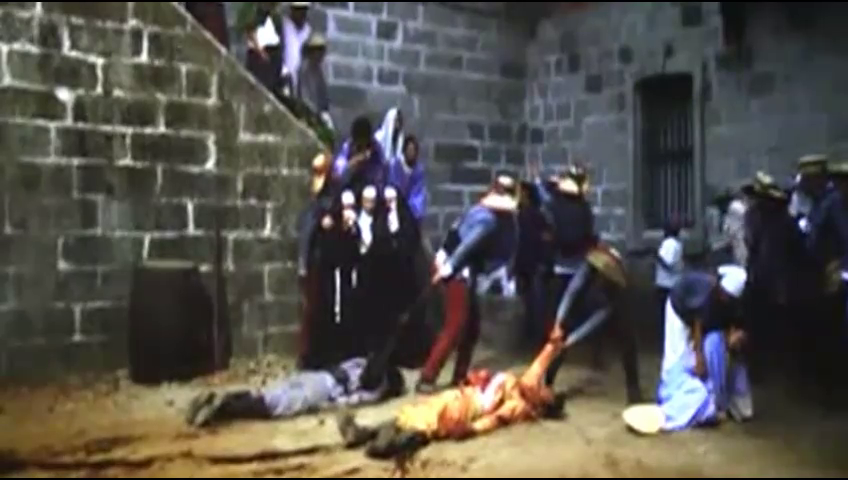
This shot is a recreation of the Spoliarium, which we know was painted by Heneral Antonio Luna’s older brother, Juan.

See the resemblance?  Everything practically led up to this.  

The Spoliarium depicts corpses of slain gladiators being dragged from a Roman arena to the wails and moans of women onlookers.  According to José Rizal, the Spoliarium “embodied the essence of our social, moral and political life: humanity in severe ordeal, humanity unredeemed, reason and idealism in open struggle with prejudice, fanaticism”.  Makes you think.

Cinematography and overall production quality
This film was surprisingly good as we can see from the Spoliarium recreation shown in the picture above.  Sure we have cardboard props, balusters whitewashed in Boysen enamel and some bits and bobs that look out of place, but it didn’t distract and it didn’t detract from its beauty and politico-social message that the film had to offer.

The film had some very beautiful shots.

I learned from some forum that this battlefield promotion may have been that of Major Torres Bugallón

It’s been a long day without you, my friend / And I’ll tell you all about it when I see you again / We’ve come a long way from where we began / Oh, I’ll tell you all about it when I see you again

Points for improvement
The film has its flaws and if I worked with Jerrold Tarog,  I would have suggested that he did a few things differently.

One is the battle where Janolino was disciplined.  The Filipinos were not on the defensive in this battle.  This incident took place during the Second Battle of Caloocan, a Filipino offensive with the aim of dislodging the American’s from Manila.  This was the last Filipino offensive and the last shot at winning the war.  

The offensive was planned as a coordinated offensive:  An attack against the American’s on several fronts as well as from behind their lines.  Needless to say, the attack failed with many historians blaming the lack of coordination among Filipino Units.  History and public opinion hasn’t been kind to Col. Janolino and his Kawit Batallion, in fact, no one can say what exactly happened to him after that incident.

Needless to say, this incident should have taken place during the offensive—at the very moment of victory—in order to highlight the dangers of insubordination, hubris and pride.

Lastly, the film could have further gone into the time when Luna lived in Europe and rubbed shoulders with the propagandists.  It would better highlight the philosophy of Philippine nationhood if ever there was one.

Conclusion
The film was not shy about being a political and social manifesto.  It struck the chords of so many Filipinos.  This must be the reason why it was successful [enough to break even] at the box office.  Even more impressive was the fact that the film was patronized by the country’s intelligentsia.  That said, I sincerely hope the audience does not miss the message about competence and excellence.  

Copyright on the images belong to the filmmakers.  If anyone finds my uploading of them to be an infringement of copyright or offensive, please do not hesitate to contact me through blogger.

Monday, October 20, 2014

Hairstyles of the 1940s

Men’s hairstyles during this time seem timeless; they are still used today with some variations from how they were originally used back in that decade.  The resilience of these looks may come from the fact that they evoke a sense of manly elegance and seriousness not captured in today’s hairstyles. 

This post will try to explain some of the salient features of this hairstyle as well as how the look is achieved.

The first half of the 1940s was wartime; the second half was a time of reconstruction in Europe and Asia and prosperity in the Americas.  Because men were generally too busy fighting and killing during this time, men’s hairstyles did not change much from the hairstyles of the 1930s.  Of course, later in the decade, innovations began to emerge such as the rockabilly and greasier hairstyles that would become prevalent in the 1950s.

As mentioned earlier, the 1940s was wartime and the hairstyles during these days were acceptable in the regular army (in contrast to today).  Soldiers back then had longer hair than they do in armies today, but at the same time they needed their hair not to get in the way, thus, hair was always short for men in the back and sides and the face was always clean shaven or otherwise had a well-groomed moustache or beard.  Men went to the barber regularly usually every 3 to 6 weeks or whenever the hair on the back of the head already touched the collar.  In European fashion, it was not rare to see a man with the sides of his head shaved with a razor (just look at pictures of German soldiers and politicians and Even Adolf Hilter as an example). 

The German Fashion
  
The top of their head, in contrast to the back and sides, was left long, especially the bangs.  This was intentionally done so that the hair can be brushed straight back.  It gives one the illusion that the hair is short but the lie is soon revealed when an individual, sporting the said hairstyle, gets into strenuous physical activity which throws hairstyle into disarray revealing long bangs that cover the forehead and sometimes over the eyes.  Just watch Godfather I where Don Vito Corleone is gunned down – look closely at his hair.


As mentioned earlier, the preference was to have the hair brushed backwards.  This was not the only way to do it.  More frequently, the hair was parted at the sides or at the center.  The center part hairstyle in those days was a little different.  It looks a bit like how Sergio Osmeña looked like in his younger days.  Needless to say, one rarely sees this style anymore. 


Sergio Osmeña 

Men used a variety of oils and pomades to achieve this.  One product was used above others – Bryllcreem – a kind of oil based, greasy hair cream.  It was invented in the 1920s and worn de rigueur by gentlemen up to the 1960s.  Indeed, it was fashionable to have shiny hair back then without comb marks and so Bryllcreem or pomade was used in conjunction with a military hair brush (which shows the military origins of this look) which is a fine brush and the use of which is to prevent comb marks on hair. 

Thus one can see that the men’s hairstyles of the 1940s combined wartime propriety and masculinity with a certain elegance that has not been captured in decades since.  This may partly explain why the style still remains popular to this day, coexisting with more modern looks.

Originally posted here:  http://proactivewriters.wordpress.com/2010/07/19/hairstyles-of-the-1940s/