Showing posts with label Current Events Opinion. Show all posts

Monday, February 12, 2018

COULD THE DENGVAXIA TRAGEDY HAVE BEEN AVOIDED?:

What might have been had Noynoy Aquino been Impeached in 2015.


Back in 2015, nobody knew of the human drama and tragedy that was about to unfold involving some 800,000 school children and their families and of the waste of some 3.5 Billion pesos worth of taxpayer’s money.  I am of course, referring to the Dengvaxia controversy.

anti-dengue%20vaccine

(Source:  CNN Philippines)


Well documented are the meetings President Aquino and his Cabinet secretaries had with Sanofi, makers of the vaccine.  It is also clear as day that regardless of the merits of the Dengvaxia vaccine, its procurement was railroaded and implemented in record time.  The whole purchase reeks of irregularity and of an administration drunk with impunity.


The timeline for this purchase was around November 2014, when the first meeting between President Aquino and Sanofi executives took place in China. Within the year, Sanofi arranged to have the drug included in the Philippine National Formulary even if it had not undergone sufficient testing.  Then, in a blitz on December 2015, Aquino and DOH Secretary Janette Garin met with Sanofi official, submitted a proposal to the DBM for its purchase and licensed the drug as a Dengue Vaccine for “all types of Individuals from 9-45 years old living in high-risk areas.”


It is simply chilling and mind-boggling to learn that this tragedy was very nearly avoided.


We recall back in July of 2014, there was a move to impeach then President Noynoy Aquino over the Disbursement Allocation Plan (DAP) controversy.  Three complaints, one filed by Oliver Lozano, another filed by Buboy Syjuco and another filed by Neri Colmenares.  The impeachment complaint was unsurprisingly thrown out in September of that year by the highly sympathetic House of Representatives.  Had the impeachment succeeded in gaining traction, the impeachment may very well have prevented the tragedy that was to become Dengvaxia.  Worse may have been that the failure of the impeachment may have further emboldened Aquino, who, unsurprisingly, used the same DAP playbook in raising the funds for Dengvaxia.

(A news report from that time)

Some have argued that the same would have been a waste of time, as it was already the twilight of Benigno Aquino III’s administration.  We could weather whatever incompetence and “Noynoying” that was about to come right?  Political stability was the more important concern back then.


Let us mull the irony of this argument for a moment.


Of course, one shouldn’t impeach an official on the basis of preventing something he/she might do just as much as one shouldn’t withhold impeachment on the argument that his/her term is about to end.  We punish an official on the basis of what he/she has done and not on the basis of damage potential.


To Impeach or not to Impeach

The takeaway is this:  It is never too late in the day to impeach an official.  Once that person has committed an impeachable offense, it is time to let him go, regardless of the damage he might or might not do.


Wednesday, November 15, 2017

POSITIVE AFFIRMATION: MAHINDRA CARS RECEIVE PRAISE FROM DUTERTE

I have been outspoken in my defense and praise of Indian automobiles.  Several articles on this blog have praised the Indian companies Tata and Mahindra. I have claimed that Indian cars are a very good fit for Philippine roads.  Specifically, I wrote:

On toughness and durability, Indian roads are some of the worst in the world.  I bet their traffic is horrible, the roads are in disrepair.  Their cars have to face extremes of heat and cold, they have to be able to climb steep mountain passes and navigate a maze of urban slums.  An Indian car has to be tough to go through that and simple--you can fix it "with a brick and a piece of string" and a hammer.


x x x

Furthermore, China does not really use diesel engines in their cars (trucks like the Foton Blizzard and the JBC are exceptions), but the Indians love diesel…”


When a PNP acquisition of Mahindra Patrol Cars came under fire from Senator Grace Poe back in 2014 for supposedly being overpriced and anomalous, I immediately jumped to their defense saying:

[T]he major concern with people is that Mahindra is an untested brand.  It has no track record in the Philippines and that it is likely to cost longer in the long run.

There is fear that a Mahindra would not last in PNP service. I beg to differ. Mahindra has been making military vehicles for a long time. The Indians have been using Mahindras for the police … they should be ideal cars for our PNP.”


0429Mahindra2


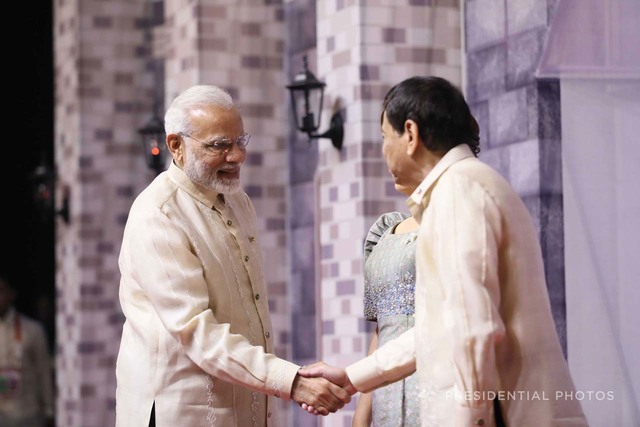
So now, during this week’s ASEAN and related Summits, we finally have affirmation from the President himself.  Earlier this week, November 13, 2017, he met with the Indian Prime Minister Narendra Modi and he allegedly told him:

The (Philippine) National Police is using Mahindra. It's one that's being used and there are a lot of them. I think there are almost 1,000 new (vehicles) and it's good. It's being used now. They are outside, they are guarding this place”

President Duterte and Indian Prime Minister Narendra Modi (source:  Rappler)

So I now feel fully vindicated in my defense of this brand.  Not only are the PNP satisfied with the longevity of these vehicles, some of which have been continuously on the road since 2014, but whose reliability has caught the attention of the President himself and had done its job of guarding foreign dignitaries attending the ASEAN and related summits without incident.


So the question remains:  Will this finally cement the reputation of Mahindra as a reputable brand of tough and rugged vehicles? That remains to be seen.

Sunday, May 7, 2017

WILL DEMOCRACY LEAD TO DEVELOPMENT IN THE PHILIPPINES?

[Note: This is an essay I wrote for university around 2009 or 2010. This would explain the ancient sources. Nevertheless, I believe that the topic this deals with is timeless and that a resolution has not yet been achieved, and so, this is my take. I have edited this for clarity and grammar, and to address points which my professor wrote in the margins of the paper.]

The question of whether democracy leads to development or is it development that lead to democracy? Is a very contentious issue in development studies? Furthermore, given the direction of said causality. How will is this apply to Philippines government policy.

In order to better understand the whether democracy brings development or vice versa, I surveyed some studies and hoped to draw a definitive conclusion to the question of causality. However the results of this review of literature were inconclusive because of the great variation in the methods and results of development literature. It seems that the assertion that economic growth will lead to political development, and the reverse, that democratization will lead to economic growth are equally valid in light of empirical testing.

In recent years however, it seems tat the idea that democracy comes before development has become more dominant than the reverse especially now that the theory that authoritarianism is more conducive to democracy has been debunked.[1] However, I find it hard to ignore the Lipset Hypothesis—that Democratic countries can only exist at a certain level of development—because of its inherent “reasonableness,” and the fact that it is an empirical regularity.[2]

I believe, as former South Korean President Kim Dae-Jung suggests, that economic growth and democratization are “Two Wheels of a Cart,” referring to the fact that both mutually support each other, [3] and in the case of the Philippines, both development and democratization must be pursued together and not at the other’s expense.

Review of Literature

The first thing one needs to understand is what is meant by the words “democracy” and “development.” Democracy can be defined in the minimalist sense—by the mere presence of elections; or leaning towards a more liberal democratic type. In fact, Larry Diamond provides a list of the kinds of government according to the degree of democracy or freedom, namely in descending order of democratization: (1) Liberal-accountable; (2) Liberal-(partially) irresponsible; (3) Semi-liberal and; (5) Pseudodemocracies.[4] There is also the Gastill Index or more commonly known as the Index of Freedom from freedom house.[5] Development, on the other hand, would refer to economic development, as in a rise in income for members of society followed by a noticeable improvement in living standards. It could be argued, however, that the development that occurs should also be of a sustainable and holistic type.

Literature that focuses on the question of the causality between democracy and development usually takes the nature of Longitudinal and Cross-sectional analyses of countries. In other words, a set of countries is chosen and amongst themselves and try to quantitatively correlate the countries’ level of development (using development indices) with political system they have. The same system is used to test if development leads to democracy or vice versa.[6] Using the same type of studies, research yields differing results. Vanhanen surveyed several studies that seem to confirm the hypothesis that development promotes democracy. Alesina and Perotti seem to have come to the same conclusion with their survey of literature. In their survey, they have studies that seem to say that democracy more often than not has a positive effect on the economic development of a country although there are studies that show a negative correlation to growth.[7]

Gerring, Bond and Brandt criticized existing studies on the direction of the causality because existing literature “rests on a set of econometric findings in which democracy is treated as a more or less immediate cause.”[8] The problem with this is that current literature neglects the importance of a country’s history in the success or failure of its democracy in bringing development.[9] The finding of their study is that democracy has a positive relationship when taken as a stock variable and not as a contemporary variable. One implication of this study therefore is the fact that the relationship between democracy and economic growth is of a non-linear nature.

In the context of this essay these literature points to three things: First, one can now see that democracy and development are not nominal terms, they have nuances, the Philippines for example is considered by most people as democratic, however, according to Larry Diamond’s categorization, the Philippines is only in the “semi-liberal” scale; secondly, one can see that development does not promote democracy and democracy does not promote development; and third, that the relationship between democracy and development is non linear (and the reverse as well, by implication) and that the fairer methodology would be to conduct country case studies.

Which Comes First?

It is either that development is conducive to democratization because of the Lipset Hypothesis that states that when people have achieved a certain level of economic and physical security will they start participating in political activity; or that democratization is conducive to development since it promotes civil and economic liberties and “human development.”[10] Thus, once can see that democracy does not contribute to growth directly, rather, it targets the source of development which is the people. Ultimately, it is in seeking both democracy and development simultaneously that one gets both.

Another argument that democracy and development should go together is the fact that survival rates of democracies increase as national incomes rise, this has been empirically proven. For example, when per capita income (in Purchasing Power Parity or PPP) is at $1,000, the democracy is expected to last about eight years. Between $2,001and $3,000, life expectancy is 26 years. Above $6,000 democracy is “immortal.”[11] Distribution of income is also very important in a democracy for the equity of distribution will affect how fast the economy grows.[12] Definitely, a democracy would need to find ways to make money or redistribute wealth efficient and equitably if it is too survive.

This may lead one to the idea that democracy promotes development indirectly: Democracy promotes development by enhancing social participation and by promoting an environment of freedom. Democracy is a system that promotes social justice, as seen in the powerful assertion of Amartya Sen that famines do not occur in true democracies.[13] Thus, a democracy ideally should allow its citizens freedom to participate in the market, as well as freedom from want of basic goods and insecurity, all of which are conducive to growth.

There is also the theory that states that when a country changes its political system after a long period of authoritarianism, there will be growth that occurs thanks to wealth redistribution and a freer and less corrupt business environment that will likely promote foreign investment in the country.[14] To an extent, this is in line with the idea guiding the Asian Development Bank’s Doing Business Indicators which study government regulations that affect how business will work in a certain country.[15]

So it seems that democracy and development support each other mutually, or like the proverbial “two wheels of a cart.” In fact, democracy and development will become more sustainable theoretically, if policies promoting both are simultaneously pursued.[16]

Development and Democracy in the Philippines

It seems that what the Philippines lacks is democracy. More specifically, this would mean that the feature of a liberal democracy, “good governance” can be improved. What governance means, in this case, pertains no only to the government, but entails the bringing together of different sectors (government, civil society, business sector, etc.) in order to achieve certain goals or development in this context. It is in this context that improving governance would necessarily include improving Philippine standing on the democracy scales.

According to the 2005 Asian Development Bank (ADB) Report on the Philippines, good governance would entail improving on the (1) accountability of officials; (2) participation of other sectors; (3) Predictability especially in the implementation of laws and (4) transparency of government.[17] Improving accountability and transparency is believed to reduce corruption and thereby improving the investment climate.[18] Participation is said to mitigate the “agency problem” or the inability of governments to implement their policies.[19] Predictability applies more specifically to the consistent application of laws. This is said to lower risks for businessmen since it makes the business atmosphere more “calculable” which is a prerequisite to taking risks.[20] Currently, politics and business in the Philippines are characterized by a lack of these basic elements of good governance. There is not much accountability as seen in the rampant corruption in the Philippines, corruption so blatant and widespread, this needs no citation. Participation from other sectors of society also seems weak as there are not many constitutional means to affect public policy—that Filipinos would often take to the streets to be heard is hardly a desirable means of participation; the barriers of getting an elective position are also prohibitively high; and that appointment to public office depends more on who a person knows than what he knows. Transparency of government is not upheld to the level that it should, as the number of journalists “killed” attests to this. Far from being predictable in terms of the consistency of the law’s application, the general sentiment appears that laws are being applied arbitrarily in the Philippines—that the law will be applied according to the ability to pay. More importantly, this “arbitrariness” is not conducive to business, a sector which would much rather prefer a “calculable” legal environment, thus hurting the country’s ability to develop capital and productive capacity, ultimately hurting the country’s ability to develop economically.[21] There are many more defects of Philippine governance worth noting, however, these four areas should already make enough of a case to say that the government should try to go higher up in the freedom scales.

In order to develop Philippine governance, particularly in the area of “participation,” the Philippines would have to raise a lot of its people from poverty—these people would have to be given the necessary material security in order for the Lipset Hypothesis to take place, thus, at least in the area of mass participation in governance, will development necessarily have to precede democratization. This has to be done while at the same time promoting democratization in other areas of government.

Conclusion

What the Philippines needs is neither development nor democracy alone, but both together. Government has to do its part to uplift the lives of its citizens in order to get them to participate in governance. The country needs good governance in order to make the country more “democratic” and thus presenting a better atmosphere for business. However, in order to uplift the lives of its poorer citizens, what is needed is a liberal democratic government as it intrinsically cares about enhancing opportunities for its citizens.

Thus, one can see that both development and democracy are mutually supporting. The development outcomes would also be much more sustainable and equitable if both development and democratization programs are applied, or more concretely, pursue democratization with a focus on where is counts for the most, in the business sectors.


[1] Halperin, M., J. Siegle & Weinstein. The Democracy Advantage: How Democracies Promote Prosperity and Peace. (New York: Routledge, 2005), p. 9.

[2] Barro, R. Determinants of Democracy. (Harvard University). P. 21.

[3] Dae-Jung, K. “Democracy and the Market Economy: Two Wheels of a Cart.” Democracy, Market Economics and Development: An Asian Perspective (Washington DC: World Bank, 2001). P. 1.

[4] Diamond, L. “Moving up out of poverty: What Does Democracy Have to Do With It?World Bank Workshop (Washington DC: World Bank, 2003). P. 21-22.

[5] Supra Note 2 P. 1.

[6] Vanhanen, T. Prospects of Democracy. (Routledge, 1997). P. 4.

[7] Alesina, A. & Perotti, R. “The Political Economy of Growth: A Critical Survey of Recent Literature.” The World Bank Economic Review (September, 1994). P. 353.

[8] Gerring, J., P. Bond, & W. Brandt. Democracy and Economic Growth: A Historical Perspective. (Unpublished Research Paper, 2004). P. 4.

[9] Ibid. P. 2.

[10] Supra Note 7 P. 354

[11] Pei, M. “Political Institutions, Democracy and Development.” Democracy, Market Economics and Development: An Asian Perspective (Washington DC: World Bank, 2001). P. 27.

[12] Supra Note 7 P. 364

[13] Sen, A. “Democracy and Social Justice” Democracy, Market Economics and Development: An Asian Perspective (Washington DC: World Bank, 2001). P. 13.
In his argument, Sen cited the example of India as not having suffered a famine since it gained its independence.

[14] Supra note 2, Abstract

[15] World Bank. Doing Business 2008: Philippines (Washington DC: World Bank) P. 1.

[16] Supra note 3

[17] Asian Development Bank. ADB Country Governance Assessment: Philippines. (Asian Development Bank, 2005) p 2.

[18] Iqbal, F & J. Il-You. Democracy, Market Economics and Development: An Asian Perspective Ibid. p 35.

[19] Ibid P. XIII

[20] Hutchcroft, P. Booty Capitalis,: The Politics of Banking in the Philippines (Ithaca NY: Cornell University Press, 1988). P 32-33.

[21] Ibid. p. 35

Thursday, December 8, 2016

DEAN STA. MARIA IN DRAWING THE WRONG CONNECTIONS MAKES HIMSELF LOOK LIKE A FOOL #LABANLENI


Dean Mel. Sta. Maria, in his InterAksyon Op Ed piece seemingly draws the connection between the firing of Vice President Leni Robredo to “future” decision of the Supreme Court acting as the Presidential Electoral Tribunal (PET).  This is so wrong on so many levels.  Let us dissect his reasoning.

In his article, Sta. Maria says:


In resigning from President Duterte’s cabinet, Vice President Leni Robredo said that she “had been warned of a plot to steal the Vice Presidency.” She stated that she had “chosen to ignore this and focus on the job at hand. But the events of recent days indicate that this plot is now being set into motion.”

This is a powerful statement. It warns of the gravest danger that may face the nation -- the thwarting of the people’s will. And since the position involved is the second highest public office in the land, it sends a message that the “plot” could not have been hatched by ordinary people, but by scheming, powerful and conspiring individuals with the means and influence to execute it.

The problem with his reasoning is that he depends on the say-so of the Vice President—a statement which was clearly made for political ends.  It seems that she made that statement in order to paint a favorable picture of herself in the eyes of the media.  She seemingly made this to portray herself as a victim and then to draw attention to a circumstance that seemingly has no relation to the fact of her firing.  Mr. Sta. Maria, Attorney Mel, when using statements such as these, it is important to take them with a grain of salt, since this is basically propaganda.

Embarrassingly, Leni Robredo, in an interview cannot even give a straight answer to the question, “how do you know of this plot?”


Factually, the statement itself isn’t logical, it is a non sequitur.  Getting fired from her HUDCC post has nothing to do with her ouster from the Vice Presidency.  The Vice President holds no real power and has no real function until such time as the President dies, or is incapacitated or is unable to discharge his functions.  There is no Constitutional requirement for the VP to be given a cabinet post.  The HUDCC post itself is a cabinet position, therefore, to be a member of the cabinet, one is expected to be a team player and only serves at the pleasure of the appointing authority.  It was therefore within the President's right to dismiss Leni the moment she stopped enjoying the President's trust and confidence.

Painting himself further into a corner, Mr. Sta. Maria speculates that something is about to go down in the Supreme Court following Leni's firing.  He casts a cloud on the Supreme Court's ability to judge a case by enumerating a number of decisions he deems “unjust”, these are:

This is the Supreme Court whose majority members are perceived -- rightly or wrongly -- to be always siding with the “elite,” the rich, the privileged, and/or people highly placed in the political ladder. And this perception has basis. It acquitted former President Gloria Macapagal Arroyo and former First Lady Imelda Marcos, granted bail to Senator Juan Ponce Enrile, adjudged absolute pardon for former President Joseph Estrada, excused Mayor Junjun Binay from sanction despite abandonment of the “Condonation doctrine,” and decided that Congressman Ronald Singson cannot be ousted as a representative because his drug-related-conviction did not concern a crime involving moral turpitude. 

This is also the Supreme Court whose majority ruled against the coconut farmers and in favor of Danding Cojuangco in the coco-levy case because, among others, there was no showing that the latter was one of the “close associates of President Marcos” -- prompting former Associate Justice Conchita Carpio-Morales, now the Ombudsman, to say that “the argument that Cojuangco was not the subordinate or close associate of the Marcoses is the biggest joke to hit the country.”

And more recently, it is the Supreme Court which decided that the dictator Ferdinand E. Marcos, whose regime looted our national treasury and ushered in a period of summary execution, forced disappearance,  torture and gross violation of human rights against the Filipino people,  be buried in the Libingan ng mga Bayani


The problem with such an enumeration is that all it does is simply to list down a number of cases he disagrees with, without explaining why the court decided in such a manner, what the merits of the winning party were, et cetera.  In other words, Sta. Maria is being unfair to the Supreme Court in casting a cloud upon their decision and future decisions without actually explaining the merits or his side.  Further, in making a list of decisions he does not agree with, Sta. Maria is delving into the field of statistics and probabilities, and such arguments cannot hold water if you took the whole "sample size" into account:  How many more decisions do you think the Supreme Court made that upheld the rights of the poor, or otherwise, decisions that Sta. Maria would agree with?  In other words, Sta. Maria committed another non sequitur.

In doing this, Atty. Sta. Maria, in spite of his “lofty” motives must always remember his Legal Ethics.  Specifically, Canon 11, Rule 11.04 of the Code of Professional Responsibility which states:

CANON 11  A lawyer shall observe and maintain the respect due to the courts and to judicial officers and should insist on similar conduct by others.

x x x

Rule 11.04  A lawyer shall not attribute to a Judge motives not supported by the record or have no materiality to the case.
Sta. Maria, in writing his column, violated this rule.  He very publicly imputed an ill motive to the Supreme Court and drew conclusions based on immaterial circumstances, i.e. very public speculation by the Vice President.  

Furthermore, Sta. Maria also violated Canon 13, Rule 13.02 of the same code which states:


CANON 13  A lawyer shall rely upon the merits of his cause and refrain from any impropriety which tends to influence, or gives the appearance of influencing the Court.


x x x

Rule 13.04  A lawyer shall not make public statements in media regarding a pending case tending to arouse public opinion for or against a party.


Admittedly, this case is sub-judice (something he calls out in his article and yet he himself violates.  What a hypocrite!), So Sta. Maria is clearly trying to preempt the Supreme Court in its decision and to poison the well in case of an unfavorable decision.


In fairness to Mr. Sta. Maria, he isn't one of the counsels or a party involved in these cases, so he may escape censure from the Supreme Court itself.  Nevertheless, for an experienced lawyer, drawing the wrong conclusions out of pure speculation and then skirting the very limits of legal ethics to air out these conclusions must be embarrassing.

No wonder his books on civil law are gathering dust on Rex Bookstore shelves. 

In defense of a contrary decision

As to the possibility of an ouster, I believe the only way this would happen is if the Supreme Court, acting as the PET would order a recount.  Mr. Sta. Maria believes that the facts and circumstances do not warrant a recount.  I believe otherwise and that Mr. Sta. Maria is simply affected by his bias.  

If you asked me, I would say that the true test of impartiality or lack of bias of a court decision is if it passes the “role reversal” test.  The role reversal test is fairly straightforward, in fiction, John Grisham used this in his book, A Time to Kill, where an African American in the deep south was facing trial for the murder of white rednecks who raped his daughter.  [spoiler alert] The protagonist used the insanity defense claiming that he was driven to insanity by the rape of his daughter leading to the redneck’s murder in a fit of insanity. In that book, the swing vote in the jury came from a woman who pleaded to the all white jury to close their eyes and imagine that the rapists were black and the victim was white.  [end spoiler] 

In this electoral protest, let us reverse the roles:  Leni is accusing Marcos of cheating, she alleged that he bought out smartmatic and tampered with the machines; dubious algorithmic progression in the increase of Marcos’ votes; and mysterious “zero” votes in some precincts as well as missing voters in a hotly contested and divisive election; with all of the machinery and infrastructure in the hands of the opposing party.  In your opinion, would a recount be called for?  Logically, you would be in favor of a recount.  Moreover, a lot of people in both camps are quite anxious to know the truth about what transpired during the elections.

Saturday, November 19, 2016

THE BOOGEYMAN IS FINALLY BURIED


I woke up this morning and I felt strangely refreshed.  It felt as though a huge weight had been lifted off of my shoulders.  As you know, the family of Former President Ferdinand E. Marcos buried him yesterday morning in a discreet and intimate burial in the Libingan ng mga Bayani (LNMB).  For the past 30 or so years after his death, Marcos had been kept in a refrigerated casket for all the world to see, his corpse was gawked at or venerated and defiled.  His mortal remains were used as a symbol by loyalists and pro-Aquino alike, sowing division.  It is because of this that President Duterte once and for all decided to put the issue and his mortal remains to rest.  Make no mistake about it, this was a political decision calculated to end division between the loyalists and the pro-Aquino—this does not change the past, but sets a course for our future unburdened by Boogeymen and infighting.


I am glad he is buried now and out of sight.  Like Mark Anthony speaking at Caesar’s funeral in Shakespeare’s play, I would simply like to say that “I have come to bury Marcos, not to praise him.  The evil that men do lives after them; the good is oft interred with their bones…”  And so it is with Marcos.  I hope you do not think that simply because he has been buried, his sins are buried with him.


julius_caesar

“The evil that men do lives after them; the good is oft interred with their bones”

Now that he has been buried, I believe that this country can now really and truly move forward.  While his corpse was above ground, he was the Boogeyman—a legendary monster, a story to spook children from misbehaving.  During the second Aquino administration, it seemed like a running joke to talk about the ills of Martial Law all the while abuses and mismanagement continued.  Our history should never be used to cover up or justify present abuse.  Neither does it justify partisanship when all camps are guilty of mismanagement and abuse.  I sincerely hope that supporters of both sides open their eyes and see things who what it is, both the loyalist camp and the pro-Aquino camp used your hatreds for political ends and took you all for a ride. 


For the victims, nothing can replace what you have lost and what you have endured.  The government has recognized this as a turbulent time in our history.  Evil heathen forces carrying Mao Zedong’s ideas and Lenin’s hammer and sickle banner were at our gates.  Marcos chose to fight fire with fire.  The jury is still out on this.  History far removed from partisanship will judge him, as God surely has already.  Today Marcos is buried and worms tear at his flesh, yet the very architects of the Martial Law regime, Juan Ponce Enrile and Former President Fidel Ramos live and enjoy a pride of place in our government.  Victims, you will get more answers and closure from the living than with the dead.


Nor do I feel like we have “violated” our history in having him buried there.  As  I said, the jury is still out on this one.  Some groups insist that we as a people are suffering collective amnesia for allowing this, but I say that we are  suffering collective amnesia about those days when Martial Law was declared.  Why was Martial Law declared?  Was it the sensible thing to do at the time?  Was it really the ultimate evil that some groups would have us  believe?  Did we benefit from Martial Law?  The jury is still out on all of these questions.  Hopefully, history will decide with impartiality. 


Let us be clear here.  This was not a “hero’s burial.”  This was a plain and simple burial.  Some groups insist that what was done was a hero’s burial.  Well, if they insist.  As earlier mentioned, when a man is buried, the evil he has done lives after him, and the good is often interred with his bones, but this is not strictly correct, Marcos’s legacy spans the full spectrum of very good to the very bad.  We knew he was after the common good, and legislation in the 1970s-80s demonstrated very forward and enlightened thinking.  Contemporary Congresses are hard pressed to match his legal corpus with laws on Muslim family relations, laws on child and youth welfare, laws on labor, laws on overseas workers, laws on land reform, laws on criminal law spanning crimes, penology and procedure, commercial laws on corporations, insurance, still in active use today! Government agencies and corporations were also created to match his vision for the country.  His legacy is not only in the realm of ideas, but also infrastructure, especially in far flung areas, and the modern demography of Mindanao owes it to Marcos’ decision to promote Mindanao as an area for lowland Filipinos to settle in.  Though, I have to admit, this has had grave consequences for the Muslims and indigenous peoples living there, leading to continuous war and strife in the region.  He has made decisions good and bad, he has made contributions both good and bad—these are a given because of his office and title, as even the most enlightened of statesmen would be forced to make difficult decisions.  Marcos was a President of this country, the hard decisions were his to make and only history can judge him now.  

the boogeyman

President, Pure Evil or “Boogeyman,” history removed from partisanship

will decide in its own good time


If there is anything I want justice for, it would be for the ill-gotten wealth.  With this burial, I hope the Presidential Commission on Good Governance (PCGG) will find renewed drive and vigor to recover the ill-gotten wealth.  Please take heart, all is not lost, as Imee Marcos has admitted, the cases for this ill-gotten wealth remain pending with the courts, so please see these cases through. 


In the meantime, the country must move on, and move on we will, less one Boogeyman and less one corpse defiled and used by supporters and detractors alike.

Thursday, November 10, 2016

RANT: LIBERALS ALL OVER THE WORLD HAVE TO REASSES THE SITUATION AND REEVALUATE THEMSELVES AND THEIR PRIORITIES


I am really tempted to gloat.  I dislike liberals of the American and even the Filipino variety, and it seems that 2016 is the year that their world fell apart for them.  Indeed, my Facebook feed is filled with their whining and gnashing of teeth.  But gloating is cruel and doing so tends to reduce the righteousness of one’s cause.  It is better to look and examine what happened?  Why did the Duterte and Trump victories catch them off guard, why did their efforts to discredit both of these people and their supporters fail?  It is too simplistic to call the supporters of these populist, firebrand politicians as bobo, retard or idiotic sheep.  Neither is it wrong to say that the liberal “cause” is wrong or unpopular—No, I think the problem is in the liberals themselves, and they should take the time to reflect, reassess and reevaluate themselves and their position.

358qda
The state of social media right now. 

How would I characterize a “liberal?”  I use this term loosely because “liberal” can mean many different things depending on context.  Generally speaking, I refer to this as a “political philosophy based on belief in progress, the essential goodness of the human race, and the autonomy of the individual and standing for the protection of political and civil liberties”  (Merriam-Webster Dictionary).  In the United States, these are usually adherents of the Democrat party.  In the Philippines, they are closely linked with the Liberal party.  In fairness to the Liberal Party, it is the closest the Philippines has to an actual political party in the cohesive, traditional and American sense of the word.  Sadly, it seems that their cohesion is due to a figurehead—the son of two so-called “heroes” who gained prominence during the Marcos regime.  The father of this figurehead was supposedly “assassinated” by then President Marcos while his mother became President of the Philippines in a bloodless coup.  This group professes to prioritize human rights, freedom of speech, are against discrimination of any sort, decent behavior and they generally have a favorable view of America and share a lot of these same beliefs with American liberals.  To be fair, a lot of these people are genuinely decent people, its just that they are misguided by their own self-righteousness.

Liberals are self-righteous and sanctimonious
Liberals are so convinced of the righteousness of their position, they welcome no opposing views and look down if not outright humiliate a person espousing a contrary view.  Right now, I dread opening my social media.  All I can see in it, as far as the eyes can see is the incessant whining and tears of Liberal Filipinos.  Its always about the same things:  the libingan ng mga bayani, Trump, Duterte, Delima, and, heck, even the Leni Robredo “tuhod” comment.  And a lot of those concerns are irrational and ad hominem, anyone who cares to point that out gets bashed and groups of liberals would band together and support one another in a circlejerk.  They are prone to superlative, such as comparing former President Ferdinand Marcos to people like Adolf Hitler, Pol Pot and Idi Amin, you know, people who have actually committed genocide as a policy of their state.  Dare to point out that you are cheapening the experience of Holocaust survivors by comparing Hitler to Marcos and you will get a faceful of hate for interrupting the circlejerk.  American liberals are hardly any different, point out the scandals that hound Hillary Clinton and you will be accused of being a misogynist.  

They have a poor grasp of the issues and arguments
To be fair, non-liberals haven’t been the best at “marketing” their position either.  Their position is one of drastic measures—great changes in policy.  They aren’t really accustomed to voicing out their discomfort and their concerns, so they won’t be masters at convincing right away.  Liberals on the other hand, are like professional “whiners” and are accustomed to having a “feel good” stance on issues.  In a way, Liberals have never tried to get our of their comfort zone.  Ask any Liberal what they think of “rape jokes” and they will tell you that “rape jokes are bad [period].”  Ask them to explain why that is the case and 9 times out of 10, you will get crickets.   

They block out contrary opinions
Another thing liberals should learn to do is to listen to contrary opinions.  Try to see where the “other guy” is coming from.  American liberals (AKA Democrats) are seemingly more prone to shutting out contrary opinion than their conservative counterparts.  Reuters reports:

Fourteen percent of respondents in the Reuters/Ipsos poll said they had blocked a family member or close friend from social media because of the election. For Democrats, this rises to 23 percent compared to 8 percent for Republicans.

This goes to show that liberal people are more likely to shut out contrary opinions and ideas from their own.  When thinking in a movement only exists in a circlejerk, critical thinking is lost and that is when the movement loses its relevance.  What better example of this behavior than the Philippine’s own Rappler, a news website with [obvious] liberal leanings, wrote a series of articles about a “propaganda war” predominantly blaming an ordinary blogger Mocha Uson for spreading propaganda thanks to her army of bots (!) hoping to put a stop to her blog.

It is also very easy to see how the liberal coastal cities of America and their wealthy residents can seem so out of touch with the rest of their countrymen.  To them, their main concern is advancing the feminist cause, gay marriage, Hollywood, legalization of Marijuana while non-liberals/Trump supporters had very different concerns:  jobs, immigration, perceived weaknesses in America’s foreign policy.  So therefore, shutting out contrary opinion and a cocooned existence don’t do wonders for liberal PR.  It just makes one seem “elitist.”

Victim Mentality
Liberals can’t seem to comprehend the idea of blaming oneself for one’s failures—they always try to portray themselves as the victim.  In Clinton’s case, she wasn’t seen as fit for the job by many democrats resulting in very low voter turnout.  I wonder if the democrats really expected an easy victory just because she was a woman running against a misogynist?  Worse was that after Trump gave his thank you speech which he tried to fill with as much hope for the future, the most memorable (and retweeted) part of Clinton’s concession speech was something about breaking the “glass ceiling.”  Are they seriously blaming their loss on the fact that she is a woman?

Its a pity that liberals played the gender card thinking that Americans will vote for a person simply on account of her gender.  I’m glad to see that meritocracy still exists in some form over there.  The same victim mentality is rampant among the liberals of the Philippines.  Best example is Senator Leila Delima who keeps bringing up her gender in her numerous press conferences with the liberal media of the Philippines.

What’s Next?
For Filipino liberals, the events of the past year should serve as a wake-up call.  Since you abhor Trump so much, perhaps it is time that you stop placing America on a pedestal and learn to think for yourselves. 

I understand and sympathize with your convictions.  In fact they are very honorable, so please don’t give up.  Learn from your shortcomings.  I will leave you with what I saw on my Facebook feed from a person that I respect has written:

I kind of just want to remind people who are blaming democracy these days that:
A) both Trump and Duterte did not grab power. Don't you just feel grateful that elections remain to be undisrupted in both countries?
B) democracy isn't suddenly wrong because things didn't go your way
C) it's democracy that will let you get up again tomorrow and start your 4 or 6 year campaign.

...
Good night!


Please be guided accordingly!

------
Note:  Please forgive the rant.  This was hastily written so I can get this out while this historic moment remains fresh.  I talk about America and the Philippines.  The near simultaneous elections we had seems to have caused a great deal of grief for many people regardless of whom you support and whatever your values are.  Also, I am no expert in American culture and politics, hence comments, suggestions and corrections are very much welcome.

Friday, November 4, 2016

WHY THE CANCELLED PHILIPPINE–AMERICAN ARMS DEAL ISN’T A BIG DEAL


The local and international media once again sensationalized a minor issue.  This time, the Philippine Star a story about a cancelled arms deal with the United State in its front page.  Worse, the Philippine Daily Inquirer tried to turn the image below into a meme.

de la rosa meme

“Bato saddened by scuttled arms deal of PNP with US”

Source:  inquirer.net


Now, whenever the media talks about guns, knowledgeable persons try not to take them seriously as their ignorance is aptly exemplified by the meme below.


Humor_funny_journalists_guide_to_firearms_ak47_glock

 source: www.mojosteve.blogspot.com

Since I think that the media sensationalized a simple issue once again, let us try to make sense of it ourselves.


Why the deal cancellation makes no sense

The deal was ostensibly cancelled out of concern for “human rights,” the Philippine Star in the abovementioned report states that:


The US State Department halted the planned sale of some 26,000 assault rifles to the Philippines’ national police after Sen. Ben Cardin said he would oppose it, Senate aides told Reuters on Monday.

Aides said Cardin, the top Democrat on the Senate Foreign Relations Committee, was reluctant for the United States to provide the weapons given concerns about human rights violations in the Philippines.

The relationship between the United States and the Philippines, a long-time ally, has been complicated lately by President Duterte’s angry reaction to criticism from Washington of his violent battle to rid the country of illegal drugs.


We know that this reasoning makes no sense because the United States has previously supplied weapons to regimes which have had questionable human rights track records previously whenever it suits them or whenever it is expedient.  Thus, proceeding from the assumption that Human Rights has absolutely nothing with this, it is safe to say therefore that our relationship was “complicated” not by human rights, but as a result of the country’s realignment or pivot to China as well as “punishment” for continued anti-US rhetoric which has confounded Obama’s own “Pivot to Asia” which many commentators have now declared a failure often citing the Philippines as an example of America’s inability to keep its allies.  This is further implied in a recent article from the Washington Post:

Reuters reported Tuesday that the State Department will stop the weapons sale because of opposition from Sen. Benjamin L. Cardin (Md.), the top Democrat on the U.S. Senate Foreign Relations Committee and a vocal critic of Duterte's "drug war."

Although the State Department did not comment to confirm or deny Reuters's reporting, the head of the Philippine National Police said in a statement that he was “saddened” by the news. Duterte, meanwhile, tried to shrug it off, dismissing the report as a U.S. “scare tactic” and saying the necessary weapons can be purchased somewhere else — like Russia.

Duterte is partly right. Stopping the sale of 26,000 guns is a small gesture, compared with the $9 million in aid that the State Department will give to counternarcotics and law enforcement programs in the Philippines in 2017 and with the $32 million that Secretary of State John F. Kerry pledged this summer for Duterte's law enforcement programs.

But it's a move that is intended to show that some U.S. funding for the Philippines can and will be cut if the president's human rights abuses and anti-U.S. rhetoric continue.


So, as the Americans understand it, this isn’t really about human rights, its about anti-US rhetoric.  Keep in mind that the US will have their elections coming up, the current Democrat-dominated government’s inability to keep their alliance with the Philippines has become ammunition by their Republican rivals.  This is retribution, plain and simple.


Duterte is not concerned though, he mentioned that if America will not sell us weapons, it is their loss, we will buy from other countries and possibly use locally produced weapons. 


M4 Carbines are of an outdated design and is a waste of money

This cancelled deal involves the sale of some 26,000 M4 Carbines.  The M4 Carbine is an updated and shortened version of the original M16 Assault Rifle designed by Eugene Stoner in the 1960s.  Philippine media may have made a big deal out of this because they cling to a belief in the superiority of American firearms, but this is simply not the case.  If you look at the credible militaries all over the world, you will see that very few of them are actually using M-16s or M4 carbines despite their availability.  In the ASEAN region, our neighbors are equipped with

Country Standard Issue Assault Rifle Comment
Indonesia Pindad SS1; Pindad SS2; SAR 21 (special forces) The SS1 is currently being phased out and will be replaced by the SS2.  Both are locally manufactured.  The SAR 21 is of a bullpup design and is imported from Singapore.  All are chambered for 5.56 x 45 mm NATO
Malaysia M4 Carbine Produced under license.  Chambered for 5.56 x 45 mm NATO
Singapore SAR 21 Bullpup configuration, locally designed and produced.  Chambered for 5.56 x 45 mm NATO
Vietnam Hodgepodge of Weapons, many Soviet and American leftovers from the war are still in use.  Modern weapons include IWI Tavor TAR-21; Galil ACE TAR-21 is a bullpup design.  Both the TAR and the Galil are of Israeli origin, the Galil is license built in Vietnam using the old 7.62 x 39 mm round.
Cambodia Variety of AK-47 and Chinese clones.  QBZ-95 (special forces) The AK variants are chambered for 7.62 x 39 mm round.  The QBZ-95 is a bullpup design and the variant in use by the Cambodians are chambered for 5.56 x 45 mm NATO.
Thailand M16A1 (phase out); IWI Tavor TAR-21; SAR 21 (special forces) The bullpup designed TAR-21 is set to replace the aging M16s in front line service.  These rifles are all chambered for 5.56 x 45 mm NATO.
Brunei M16A1/A2/A4; SAR 21; Pindad SS2 All are chambered for 5.56 x 45 mm NATO.
Other reference countries                                                                                              
Japan Howa Type 89 Chambered for 5.56 x 45 mm NATO
India 1B1 INSAS Locally designed and produced, chambered for 5.56 x 45 mm NATO, standard configuration


As the table shows, American assault rifles are, in general, being phased out, and countries tend to be gravitating towards the “bullpup” configuration as exemplified by the TAR-21 and SAR 21.  The M4 carbine is simply a bit old fashioned, it seems bulky and front heavy compared to the SAR, TAR or even Cambodia’s QBZ imports from China.  Worse is that American built M4s are simply not as robust as other models and requires too much maintenance, this was a glaring deficiency discovered as far back as the Vietnam war.  No wonder none of our neighbors are modernizing to these guns.  Are these really the sorts of weapons we want to be equipping our police officers?  They will be fighting house to house, in cramped urban environments, in jungles, they might want a modern bullpup design.  It seems to me that the M4 was only chosen because of our familiarity with the design and because it seems that the US is treating the Philippines is a “captive market” for US arms, we never having had a real opportunity to field test the assault rifles of other nations or to develop our own.  Basically, we should just buy the best weapons for the best price, if that means buying Israeli, Indonesian or Chinese weapons, then so be it!


Ammunition compatibility

We may also make a big deal out of a supposed compatibility of existing ammunition with rifles not made by the United States.  This is important because it simplifies logistics and acquisition of weapons and ammunition.  But the mere fact that America refuses to sell us its rifles isn’t as big of a deal as it once was.  During the Cold War, both the West and the Soviet bloc standardized ammunition and magazines to the “NATO Standard,” likewise, the Soviet Bloc adhered to the Warsaw Pact standard.  This means that if two countries belonging to either the NATO or Warsaw standard  Ammunition is fairly standard among


Thus assuming we were to find other sources of arms from the Western Bloc, there would be absolutely no compatibility issues using their arms with our existing stockpiles of ammunition and magazines.  This is how we are able to supply Steyr AUG assault rifles to our elite troops with no compatibility issues because the Steyr chambers the same 5.56 x 45 mm NATO round that the M4 does in the same STANAG magazines.


Obviously, sourcing weapons from former Soviet Bloc and Chinese countries will cause some issues, but again, the issues are not as difficult to overcome as they may seem.  It is a well known fact that both Russia and the former Soviet republics and China are producing arms for export, that variants of their arms exists that are chambered for the NATO standard.  The government, in dealing with the Chinese or former Soviet bloc countries just has to make sure that they are getting weapons of compatible calibers.


A blessing in disguise to the local arms industry?

Duterte has mentioned that the Philippines has its own firearms industry.  This is true, and the fact is, given the situation, we should seriously be looking into the possibility of tapping into our local manufacturers for locally designed and produced weaponry as our Singaporean and Indonesian neighbors are currently doing.


Among the pro gun groups in the Philippines, many were quite worried that, in spite of the vibrant gun culture in the Philippines, local arms manufacture would soon cease.  This was because during the time of PNP Chief Alan Purisima, he implemented extremely onerous registration requirements for gun owners.  A firearms owners group, PROGUN has successfully obtained a temporary restraining order against the IRR and has taken the fight to the Senate, but nevertheless, the damage has been done.  Around 2014 – 2015, the ammunition and firearms industry chafed under this regulatory regime and thousands were laid off.  ARMSCOR, a reputable manufacturer based in Marikina City had to lay off 450 workers during this time.

purisima

Former PNP Chief Alan Purisima almost destroyed our arms manufacturing industry, for what?  Kickbacks on firearms registration from honest gun owners.


Will the current administration help to undo the damage that was done to our industry?  Perhaps it should.  Duterte, a self-avowed Socialist, will readily see that a government infusion of funds into industries wherein we have a competitive advantage, will reap huge dividends.  Government can advance money to possible manufacturers for the for the production of prototypes for the approval of the government.  Once a design is approved and an order is made, Government should advance some money for the construction of factories, hiring of workers and the building of a production line.  The rest of the money can be paid after the delivery of the arms.  All this can be done in 2 to 3 years through proper motivation.  None of this is wishful thinking either.  The Philippines already exports firearms to countries such as the United States and Thailand.  Most of these are sporting rifles and home-defense revolvers, but the innate capacity is already there.


In spite of all of his recent bluster, I believe that developing a local armaments industry is something that Former President Fidel Ramos will approve of.  After all, it was during his administration that we embarked on a [stalled] modernization of the AFP and under whom prototypes of helicopters were even produced in the hope they they would enter active service.


Note that the cancelled deal was actually a sale that was supposed to take place, this means that funds are actually going to be freed up to fund investments or purchases of arms from other countries, so this isn’t a big loss, and merely represents a delay in the acquisition of new assault rifles.


Conclusion

The cancellation of the arms deal is nothing to cry over.  This is probably just America’s way of protesting Duterte’s pivot to China.  Not that this is a big loss, better and cheaper arms can be found elsewhere.  If the United States does not want our money, there are other countries that would love to sell to us.  In the meantime, we should try and take this as an opportunity to depend too much on America, nor should we be beholden to their products, and to develop indigenous capability to produce our own weapons. 


Related:

 Mahindra Trucks:  The PNP Appears Satisfied

On the arms disparity between the Philippines and China

Turning the Bangsamoro region into a politico-military complex


Sunday, September 4, 2016

WAR ON DRUGS:


A GAME OF THE GENERALS


To those not familiar, Game of the Generals is a board game, which involve two players moving pieces on a board, much like the better known game of chess.  This game, unlike chess, introduces an element of deceit and “fog-of-war”.


In a “General’s” game, the player sets up his pieces in a freeform manner, and tries to protect his flag while trying to outflank his opponent and capture his “flag” unit. Each piece belongs to one of several unit types each with varying strengths with different qualities, the exact unit type is not known to the opponent as each piece is undistinguishable from another, save for markings which only the unit owner and the referee (a neutral third person) can see.  For example, a piece known as the “5-star general” can pretty much “kill” any other opposing unit, but is vulnerable to a “spy” unit; spies however, can be killed by a “private”.  The way a player arranges his pieces and how well he presents his “poker face” to the public, are factors that come into play in this game.


This war on drugs is figuratively and quite literally a game of the Generals.  Figuratively, because there is always an element of deception, and literally because of the personalities who may be involved.


Now, what I am about to say contains a lot of speculation and opinion. A lot of this is hearsay, so take this with a grain of salt, but these rumors are so widespread now that this is what the “non-chattering” public would claim to be the truth.


The Executive Department as a Neutral Referee
Quite literally, it seems that the Executive department, under the watch of President Duterte is acting as a “Neutral Referee”—the third man in a Game of the Generals match.  The referee in this case is a non player, all he does is watch the game progress and calls out which piece wins a challenge.  He lets the players have at it with one another.  In this case, he merely watches as the drug lords, their coddlers and the low level pushers make mince meat out of one another.  He is content and satisfied to watch the players destroy one another as the narcotics trade in the country implodes from within.  And, like a mischievous referee, he would sometimes drop hints about “who” these pieces on the board really are, to the glee of the captive Filipino audience clamoring for blood.


In a word, it is “masterful” 
First, it was low level pushers, the lieutenants, dropping one by one.  The public has accepted that these deaths (I dare not glorify it with the use of the term, “Extrajudicial Killing”) were perpetrated by corrupt policemen, mayors and drug lords trying to cover any evidence.  Now, the drug lords and the mayors themselves seems to be the targets—the coddlers of the low level pushers are now the targets of their coddlers.


Who are these coddlers of the drug lords?  It seems that these are people in high places.  These are your senators and generals.  Take the case of the recently slain Melvin “Dragon” Odicta.  It is widely known (rumored) that he has connections with some powerful senators.  He spoke with DILG Secretary Mike Sueno and suggested that he surrender to the police with “some conditions”.  This didn’t help him though.  The widely circulating rumor is that he was killed by some police and military men.  The lawyers who were supposed to meet him were being prevented from coming to him.  Clearly, somebody powerful and with a high position wanted him silenced.


Who killed the Dragon?


Another example is the currently at large (or should we presume him dead?) druglord Kerwin Espinosa who has supposed links with a “senator”


Rolando Espinosa:  Look at his pitiable mug. 
I wouldn’t want to be him


Given these circumstances, all I can say is "Wow".  It looks like the Executive department decided to let the drug lords and their coddlers play a game of the generals with one another and he is the referee.  Masterful.


A Word of Advice to Drug Lords and Pushers (NSFW)
You know who you are, and you know who are after you.  You weren’t born yesterday and your predicament certainly didn’t happen overnight.


Turn yourselves over to the police, tell them who and what you know.


If this doesn’t sound enticing, please, strongly consider the alternative.  Kill your coddler.  If you are a pusher, kill the mayor who coddles you.  If you are the mayor, kill the general who coddles you.  If you are the general, please kill the senator who coddles you.  Dead men tell no tales.  Kill him first, before he kills you.


Meanwhile, the common, sit glued before their TV sets and tabloids cheering on as more and more of your kind get your well-deserved deaths.


Endnote
We’ve all heard about the Davao City bombing, I just want to say that my sympathies go out to the victims and those left behind.  Terrorism, like drugs, is one of those ills which needs to be snuffed out of our country before things go out of control.

#staystrongDavao #OneNation #thearchipelago