Showing posts with label Culture. Show all posts

Sunday, May 7, 2017

WILL DEMOCRACY LEAD TO DEVELOPMENT IN THE PHILIPPINES?

[Note: This is an essay I wrote for university around 2009 or 2010. This would explain the ancient sources. Nevertheless, I believe that the topic this deals with is timeless and that a resolution has not yet been achieved, and so, this is my take. I have edited this for clarity and grammar, and to address points which my professor wrote in the margins of the paper.]

The question of whether democracy leads to development or is it development that lead to democracy? Is a very contentious issue in development studies? Furthermore, given the direction of said causality. How will is this apply to Philippines government policy.

In order to better understand the whether democracy brings development or vice versa, I surveyed some studies and hoped to draw a definitive conclusion to the question of causality. However the results of this review of literature were inconclusive because of the great variation in the methods and results of development literature. It seems that the assertion that economic growth will lead to political development, and the reverse, that democratization will lead to economic growth are equally valid in light of empirical testing.

In recent years however, it seems tat the idea that democracy comes before development has become more dominant than the reverse especially now that the theory that authoritarianism is more conducive to democracy has been debunked.[1] However, I find it hard to ignore the Lipset Hypothesis—that Democratic countries can only exist at a certain level of development—because of its inherent “reasonableness,” and the fact that it is an empirical regularity.[2]

I believe, as former South Korean President Kim Dae-Jung suggests, that economic growth and democratization are “Two Wheels of a Cart,” referring to the fact that both mutually support each other, [3] and in the case of the Philippines, both development and democratization must be pursued together and not at the other’s expense.

Review of Literature

The first thing one needs to understand is what is meant by the words “democracy” and “development.” Democracy can be defined in the minimalist sense—by the mere presence of elections; or leaning towards a more liberal democratic type. In fact, Larry Diamond provides a list of the kinds of government according to the degree of democracy or freedom, namely in descending order of democratization: (1) Liberal-accountable; (2) Liberal-(partially) irresponsible; (3) Semi-liberal and; (5) Pseudodemocracies.[4] There is also the Gastill Index or more commonly known as the Index of Freedom from freedom house.[5] Development, on the other hand, would refer to economic development, as in a rise in income for members of society followed by a noticeable improvement in living standards. It could be argued, however, that the development that occurs should also be of a sustainable and holistic type.

Literature that focuses on the question of the causality between democracy and development usually takes the nature of Longitudinal and Cross-sectional analyses of countries. In other words, a set of countries is chosen and amongst themselves and try to quantitatively correlate the countries’ level of development (using development indices) with political system they have. The same system is used to test if development leads to democracy or vice versa.[6] Using the same type of studies, research yields differing results. Vanhanen surveyed several studies that seem to confirm the hypothesis that development promotes democracy. Alesina and Perotti seem to have come to the same conclusion with their survey of literature. In their survey, they have studies that seem to say that democracy more often than not has a positive effect on the economic development of a country although there are studies that show a negative correlation to growth.[7]

Gerring, Bond and Brandt criticized existing studies on the direction of the causality because existing literature “rests on a set of econometric findings in which democracy is treated as a more or less immediate cause.”[8] The problem with this is that current literature neglects the importance of a country’s history in the success or failure of its democracy in bringing development.[9] The finding of their study is that democracy has a positive relationship when taken as a stock variable and not as a contemporary variable. One implication of this study therefore is the fact that the relationship between democracy and economic growth is of a non-linear nature.

In the context of this essay these literature points to three things: First, one can now see that democracy and development are not nominal terms, they have nuances, the Philippines for example is considered by most people as democratic, however, according to Larry Diamond’s categorization, the Philippines is only in the “semi-liberal” scale; secondly, one can see that development does not promote democracy and democracy does not promote development; and third, that the relationship between democracy and development is non linear (and the reverse as well, by implication) and that the fairer methodology would be to conduct country case studies.

Which Comes First?

It is either that development is conducive to democratization because of the Lipset Hypothesis that states that when people have achieved a certain level of economic and physical security will they start participating in political activity; or that democratization is conducive to development since it promotes civil and economic liberties and “human development.”[10] Thus, once can see that democracy does not contribute to growth directly, rather, it targets the source of development which is the people. Ultimately, it is in seeking both democracy and development simultaneously that one gets both.

Another argument that democracy and development should go together is the fact that survival rates of democracies increase as national incomes rise, this has been empirically proven. For example, when per capita income (in Purchasing Power Parity or PPP) is at $1,000, the democracy is expected to last about eight years. Between $2,001and $3,000, life expectancy is 26 years. Above $6,000 democracy is “immortal.”[11] Distribution of income is also very important in a democracy for the equity of distribution will affect how fast the economy grows.[12] Definitely, a democracy would need to find ways to make money or redistribute wealth efficient and equitably if it is too survive.

This may lead one to the idea that democracy promotes development indirectly: Democracy promotes development by enhancing social participation and by promoting an environment of freedom. Democracy is a system that promotes social justice, as seen in the powerful assertion of Amartya Sen that famines do not occur in true democracies.[13] Thus, a democracy ideally should allow its citizens freedom to participate in the market, as well as freedom from want of basic goods and insecurity, all of which are conducive to growth.

There is also the theory that states that when a country changes its political system after a long period of authoritarianism, there will be growth that occurs thanks to wealth redistribution and a freer and less corrupt business environment that will likely promote foreign investment in the country.[14] To an extent, this is in line with the idea guiding the Asian Development Bank’s Doing Business Indicators which study government regulations that affect how business will work in a certain country.[15]

So it seems that democracy and development support each other mutually, or like the proverbial “two wheels of a cart.” In fact, democracy and development will become more sustainable theoretically, if policies promoting both are simultaneously pursued.[16]

Development and Democracy in the Philippines

It seems that what the Philippines lacks is democracy. More specifically, this would mean that the feature of a liberal democracy, “good governance” can be improved. What governance means, in this case, pertains no only to the government, but entails the bringing together of different sectors (government, civil society, business sector, etc.) in order to achieve certain goals or development in this context. It is in this context that improving governance would necessarily include improving Philippine standing on the democracy scales.

According to the 2005 Asian Development Bank (ADB) Report on the Philippines, good governance would entail improving on the (1) accountability of officials; (2) participation of other sectors; (3) Predictability especially in the implementation of laws and (4) transparency of government.[17] Improving accountability and transparency is believed to reduce corruption and thereby improving the investment climate.[18] Participation is said to mitigate the “agency problem” or the inability of governments to implement their policies.[19] Predictability applies more specifically to the consistent application of laws. This is said to lower risks for businessmen since it makes the business atmosphere more “calculable” which is a prerequisite to taking risks.[20] Currently, politics and business in the Philippines are characterized by a lack of these basic elements of good governance. There is not much accountability as seen in the rampant corruption in the Philippines, corruption so blatant and widespread, this needs no citation. Participation from other sectors of society also seems weak as there are not many constitutional means to affect public policy—that Filipinos would often take to the streets to be heard is hardly a desirable means of participation; the barriers of getting an elective position are also prohibitively high; and that appointment to public office depends more on who a person knows than what he knows. Transparency of government is not upheld to the level that it should, as the number of journalists “killed” attests to this. Far from being predictable in terms of the consistency of the law’s application, the general sentiment appears that laws are being applied arbitrarily in the Philippines—that the law will be applied according to the ability to pay. More importantly, this “arbitrariness” is not conducive to business, a sector which would much rather prefer a “calculable” legal environment, thus hurting the country’s ability to develop capital and productive capacity, ultimately hurting the country’s ability to develop economically.[21] There are many more defects of Philippine governance worth noting, however, these four areas should already make enough of a case to say that the government should try to go higher up in the freedom scales.

In order to develop Philippine governance, particularly in the area of “participation,” the Philippines would have to raise a lot of its people from poverty—these people would have to be given the necessary material security in order for the Lipset Hypothesis to take place, thus, at least in the area of mass participation in governance, will development necessarily have to precede democratization. This has to be done while at the same time promoting democratization in other areas of government.

Conclusion

What the Philippines needs is neither development nor democracy alone, but both together. Government has to do its part to uplift the lives of its citizens in order to get them to participate in governance. The country needs good governance in order to make the country more “democratic” and thus presenting a better atmosphere for business. However, in order to uplift the lives of its poorer citizens, what is needed is a liberal democratic government as it intrinsically cares about enhancing opportunities for its citizens.

Thus, one can see that both development and democracy are mutually supporting. The development outcomes would also be much more sustainable and equitable if both development and democratization programs are applied, or more concretely, pursue democratization with a focus on where is counts for the most, in the business sectors.


[1] Halperin, M., J. Siegle & Weinstein. The Democracy Advantage: How Democracies Promote Prosperity and Peace. (New York: Routledge, 2005), p. 9.

[2] Barro, R. Determinants of Democracy. (Harvard University). P. 21.

[3] Dae-Jung, K. “Democracy and the Market Economy: Two Wheels of a Cart.” Democracy, Market Economics and Development: An Asian Perspective (Washington DC: World Bank, 2001). P. 1.

[4] Diamond, L. “Moving up out of poverty: What Does Democracy Have to Do With It?World Bank Workshop (Washington DC: World Bank, 2003). P. 21-22.

[5] Supra Note 2 P. 1.

[6] Vanhanen, T. Prospects of Democracy. (Routledge, 1997). P. 4.

[7] Alesina, A. & Perotti, R. “The Political Economy of Growth: A Critical Survey of Recent Literature.” The World Bank Economic Review (September, 1994). P. 353.

[8] Gerring, J., P. Bond, & W. Brandt. Democracy and Economic Growth: A Historical Perspective. (Unpublished Research Paper, 2004). P. 4.

[9] Ibid. P. 2.

[10] Supra Note 7 P. 354

[11] Pei, M. “Political Institutions, Democracy and Development.” Democracy, Market Economics and Development: An Asian Perspective (Washington DC: World Bank, 2001). P. 27.

[12] Supra Note 7 P. 364

[13] Sen, A. “Democracy and Social Justice” Democracy, Market Economics and Development: An Asian Perspective (Washington DC: World Bank, 2001). P. 13.
In his argument, Sen cited the example of India as not having suffered a famine since it gained its independence.

[14] Supra note 2, Abstract

[15] World Bank. Doing Business 2008: Philippines (Washington DC: World Bank) P. 1.

[16] Supra note 3

[17] Asian Development Bank. ADB Country Governance Assessment: Philippines. (Asian Development Bank, 2005) p 2.

[18] Iqbal, F & J. Il-You. Democracy, Market Economics and Development: An Asian Perspective Ibid. p 35.

[19] Ibid P. XIII

[20] Hutchcroft, P. Booty Capitalis,: The Politics of Banking in the Philippines (Ithaca NY: Cornell University Press, 1988). P 32-33.

[21] Ibid. p. 35

Tuesday, November 10, 2015

WORST INK STILL BETTER THAN THE BEST MEMORY?


When you snap a picture with your cellphone or digital camera, what do you do with it?  Do you still have it “developed”?  When your company asks for a report, do you still print it out or would it exist only in some computer or backed up in Dropbox or some cloud storage?    When you read a book, “do you read it off the screen just like everyone else” or do you still flip through pages like they did in days of old?

Argentine Humanist Alberto Manguel had this to say:

Even the newer electronic technologies cannot approach the experience of handling an original publication. As any reader knows, a printed page creates its own reading space, its own physical landscape in which the texture of the paper, the colour of the ink, the view of the whole ensemble acquire in the reader’s hands specific meanings that lend tone and context to the words. (Columbia University’s librarian Patricia Battin, a fierce advocate for the microfilming of books, disagreed with this notion. “The value,” she wrote, “in intellectual terms, of the proximity of the book to the user has never been satisfactorily established.” There speaks a dolt, someone utterly insensitive, in intellectual or any other terms, to the experience of reading.)

But above all, the argument that calls for electronic reproduction on account of the endangered life of paper is a false one. Anybody who has used a computer knows how easy it is to lose a text on the screen, to come upon a faulty disk or CD, to have the hard drive crash beyond all appeal. The tools of the electronic media are not immortal. The life of a disk is about seven years; a CD-ROM lasts about ten. In 1986, the BBC spent two and a half million pounds creating a computer-based, multi-media version of the Domesday Book, the eleventh-century census of England compiled by Norman monks.

More ambitious than its predecessor, the electronic Domesday Book contained 250,000 place names, 25,000 maps, 50,000 pictures, 3,000 data sets and 60 minutes of moving pictures, plus scores of accounts that recorded “life in Britain” during that year. Over a million people contributed to the project, which was stored on twelve-inch laser disks that could only be deciphered by a special BBC microcomputer. Sixteen years later, in March 2002, an attempt was made to read the information on one of the few such computers still in existence. The attempt failed. Further solutions were sought to retrieve the data, but none was entirely successful. “There is currently no demonstrably viable technical solution to this problem,” said Jeff Rothenberg of the Rand Corporation, one of the world experts on data preservation, called in to assist. “Yet, if it is not solved, our increasingly digital heritage is in grave risk of being lost.”  By contrast, the original Domesday Book, almost a thousand years old, written in ink on paper and kept at the Public Record Office in Kew, is in fine condition and still perfectly readable.

The director for the electronic records archive program at the National Archives and Records Administration of the United States confessed in November 2004 that the preservation of electronic material, even for the next decade, let alone for eternity, “is a global problem for the biggest governments and the biggest corporations all the way down to individuals.” Since no clear solution is available, electronic experts recommend that users copy their materials onto CDs, but even these are of short duration. The lifespan of data recorded on a CD with a CD burner could be as little as five years. In fact, we don’t know for how long it will be possible to read a text inscribed on a 2004 CD. And while it is true that acidity and brittleness, fire and the legendary bookworms threaten ancient codexes and scrolls, not everything written or printed on parchment or paper is condemned to an early grave. A few years ago, in the Archeological Museum of Naples, I saw, held between two plates of glass, the ashes of a papyrus rescued from the ruins of Pompeii. It was two thousand years old; it had been burnt by the fires of Vesuvius, it had been buried under a flow of lava—and I could still read the letters written on it, with astonishing clarity. (footnotes omitted)
The Beauty of Books 

Manuscripts and typescript drafts can easily be read if they are found.  You will also be able to find a wealth of meaning by examining various versions of the manuscript versus the published version.  But the ephemeral nature of electronic word processing makes it difficult to find the same level of textual analysis from authors.  With the advent of electronic composition and storage of books is the elimination and disappearance of drafts.  In the past, an author would make a series of drafts before coming up with a final manuscript.  Historians, hagiographers, biographers and other academics would find these drafts a very rich source of what the author was trying to write and what he was trying to say.  Remember José Rizal's lost chapter in the Noli Me Tangere, a chapter thatwas later included in some critical editions.  Jefferson's drafts of the declaration of liberty have been examined over and over again by historians and political scientists seeking to “get into Jefferson's brain.”  In this blog, I have an ongoing project to write a study guide of Los Pájaros de Fuego, the “lost novel” of José Balmori, is based on the critical edition of Isaac Donoso which contains glosses of previous drafts of the novel.

There are legal implications as well.  In the Philippine setting, legal instruments are, without exception, paper documents.  For example, there is no such thing as a “video will”.  In other legal traditions, we have the UK Parliament, where a law is only formally passed once it is printed in parchment.  Indeed, the durability of parchment and ink and paper and ink is not something we can easily replicate with the electronic medium.

What is the legal status therefore, of so called “electronic titles”?  Of late, the Land Registation Authority (LRA) has been digitizing the land records of our country.  Basically, all physical titles on file with the LRA are scanned and kept in a server somewhere in Scandinavia.1  A law professor discussed that these electronic titles have no legal status.  The only title to land in the Philippines is the physical certificate of title on file with the LRA, and thus the title can still be physically destroyed and the scanned copy on file somewhere in Norway cannot simply replace the physical title. 

Imagine also if something were to happen to the hard drive in Norway, and everything up in the cloud were to suddenly disappear—all of the precious digital-only land title system would be in complete disarray.  People had a big row if Facebook or Instagram would suddenly go down and all of their precious pictures and memories with it, how much more the indefeasibility of a person’s ownership of a parcel of land?

The Feared Blue Screen of Death

What do you guys think?  Paper or electronic?

Footnotes:

[1] This is just an example, but many servers are located in Scandinavia to take advantage of cold weather to save on airconditioning costs.


Saturday, October 17, 2015

HENERAL LUNA: CRITICAL REFLECTIONS

Many people before me have written about Heneral Luna and they have generally found it to be a breath of fresh air in Philippine cinema.  We have a local film industry that is generally devoid of critical fare, the industry being flooded with infidelity movies and slapstick comedies.  

That said, I must admit that when I first saw the billboard for the film along EDSA before it came out, I knew that it was going to be a compelling film—Heneral Luna is simply a very compelling and controversial character in our history.  He was a renowned tactician and able general, educated in Europe, hotheaded and outspoken.  Lived violently and died violently under mysterious circumstances (read: assassinated.  And by whom?  We may never know).  My interest was piqued.  


Then the film came out and the reviews came pouring in.  Due to my busy schedule, I wasn’t able to watch the film right away.  But I’ve read enough good reviews that when I stepped into the theater, I had incredibly high expectations for the film. Thankfully, the film didn’t disappoint.

Some other interesting reviews and critical reflections
CNN Philippines – Heneral Luna Review
Asian Journal – Heneral Luna the Movie

This is my reflection and review.

Overview
At the outset, the film stated that it took liberties with some facts and with the timeline, so some suspension of disbelief was needed.  And lets be frank, this film was a political and social manifesto directed towards the Filipino at large.   Viewed in this light, the message and the delivery of the message makes sense.

Reflections
The film immediately admits of multiple interpretations.  One may consider it a call for patriotism and heroism.  My takeaway from the film however is more basic:  It is a call for excellence and a call to turn away from the petty pride that afflicts our society and nation.  There was a point early on in the film where Luna tried to distribute uniforms to the regular soldiers saying: “Kakaunti lang ang salapi ng sandatahan ngunit kailangan na ipakita natin sa Amerikano na kagalang galang tayo.”  This is part of a larger message about striving for excellence as a people.

Throughout the bulk of the film, Luna was shown trying to command a united front, trying to keep the Americans in Manila and trying to prevent them from breaking out into the North.  The work ethic and strict discipline he imposed quickly earned him the ire of other commanders who were content to siesta and fiesta their way even in the midst of a military campaign.  The portrayal, and rightly so, was in favor of Luna’s disciplinarian style and tactical and strategic competence.  Competence, efficiency and results orientation, in Tarog’s world, trumps petty rivalries, pride and regionalism—all the more so when the stakes are LIBERTY or DEATH.  This is how it is in the real world and in the movie world.

When was the last time we saw such a stirring sight as an army of laborers off to a civil engineering project?  Our country it seems, has never had the experience of implementing public works on a grand scale

Another clear message in the film is that Family isn’t everything.  Luna goes on the claim that the Philippines cannot progress from what it currently is if the people can’t think beyond the family.  I understand that Filipinos are a family-oriented people, however, this is a crutch.  Because we see the family as a support-system, it hinders us from thinking and acting independently.  It also makes us prone to nepotism as a culture.  On one hand were shown the family-oriented Buencamino and Paterno trying to protect their businesses in order to maintain their family’s standard of living.  On the other hand, we have Luna allowing his brother to rot in jail because he knows that nobody is above the law even if he could have used his influence to have his brother freed.  Oh and don’t get me started on the officers taking their families’ along for a train ride on a train meant to transport soldiers.

Speaking of the law, the film also makes it clear that in order to have a progressive society, we must allow the law to apply to everyone equally, no matter how rich or powerful they are.  This message is unequivocal.

No one is higher than the law! - Not even sidewalk vendors.
Characterization
I am glad that the film tried to portray Luna as more than just a one dimensional character.  He, like his rivals Buencamino and Paterno had a family to take care of, has his own desires and temptations.

I must say though that the historical Luna, from what I already knew about him, would probably have approved of the message of the film--he had a conception of the “Filipino Nation”.  Note that he was educated in Spain and rubbed shoulders with the propagandists during that period.  

Aguinaldo was also portrayed as a divided character.  He won’t hesitate to purge his ranks of malcontents (he was practically a dictator after all!), but he didn’t have to like it.  Ghosts of the past haunted him all throughout.


The Americans portayed at film I think served as proxies for how the international community views us.

“You killed the only real general you had.”

They had to show Luna the respect he deserved as a foe, but you can see that they had little respect for any other Filipino.

Treatment of gore
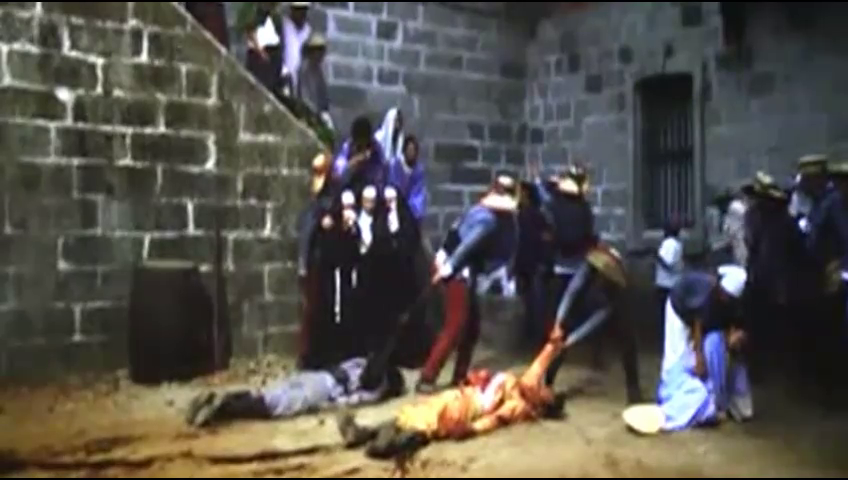
I know that Filipino movies generally shy from depictions of gore.  This film though was not shy about showing a guy’s head getting blown off or a man’s severed leg. Luna’s death was also a bloodfest.  

The gore had a place in the story however:  One, it goes to show that war is not a pretty or glorious thing but in spite of this, Luna continues to lead his men and tries to keep up to date on the situation on the frontlines--not an easy thing; another is that it sets the audience up for one of its most iconic scenes.

I especially liked this shot.

A Filipino Child Brutally Murdered

Definitely this one.

But this shot is the most poignant.

This shot is a recreation of the Spoliarium, which we know was painted by Heneral Antonio Luna’s older brother, Juan.

See the resemblance?  Everything practically led up to this.  

The Spoliarium depicts corpses of slain gladiators being dragged from a Roman arena to the wails and moans of women onlookers.  According to José Rizal, the Spoliarium “embodied the essence of our social, moral and political life: humanity in severe ordeal, humanity unredeemed, reason and idealism in open struggle with prejudice, fanaticism”.  Makes you think.

Cinematography and overall production quality
This film was surprisingly good as we can see from the Spoliarium recreation shown in the picture above.  Sure we have cardboard props, balusters whitewashed in Boysen enamel and some bits and bobs that look out of place, but it didn’t distract and it didn’t detract from its beauty and politico-social message that the film had to offer.

The film had some very beautiful shots.

I learned from some forum that this battlefield promotion may have been that of Major Torres Bugallón

It’s been a long day without you, my friend / And I’ll tell you all about it when I see you again / We’ve come a long way from where we began / Oh, I’ll tell you all about it when I see you again

Points for improvement
The film has its flaws and if I worked with Jerrold Tarog,  I would have suggested that he did a few things differently.

One is the battle where Janolino was disciplined.  The Filipinos were not on the defensive in this battle.  This incident took place during the Second Battle of Caloocan, a Filipino offensive with the aim of dislodging the American’s from Manila.  This was the last Filipino offensive and the last shot at winning the war.  

The offensive was planned as a coordinated offensive:  An attack against the American’s on several fronts as well as from behind their lines.  Needless to say, the attack failed with many historians blaming the lack of coordination among Filipino Units.  History and public opinion hasn’t been kind to Col. Janolino and his Kawit Batallion, in fact, no one can say what exactly happened to him after that incident.

Needless to say, this incident should have taken place during the offensive—at the very moment of victory—in order to highlight the dangers of insubordination, hubris and pride.

Lastly, the film could have further gone into the time when Luna lived in Europe and rubbed shoulders with the propagandists.  It would better highlight the philosophy of Philippine nationhood if ever there was one.

Conclusion
The film was not shy about being a political and social manifesto.  It struck the chords of so many Filipinos.  This must be the reason why it was successful [enough to break even] at the box office.  Even more impressive was the fact that the film was patronized by the country’s intelligentsia.  That said, I sincerely hope the audience does not miss the message about competence and excellence.  

Copyright on the images belong to the filmmakers.  If anyone finds my uploading of them to be an infringement of copyright or offensive, please do not hesitate to contact me through blogger.

Monday, October 20, 2014

Hairstyles of the 1940s

Men’s hairstyles during this time seem timeless; they are still used today with some variations from how they were originally used back in that decade.  The resilience of these looks may come from the fact that they evoke a sense of manly elegance and seriousness not captured in today’s hairstyles. 

This post will try to explain some of the salient features of this hairstyle as well as how the look is achieved.

The first half of the 1940s was wartime; the second half was a time of reconstruction in Europe and Asia and prosperity in the Americas.  Because men were generally too busy fighting and killing during this time, men’s hairstyles did not change much from the hairstyles of the 1930s.  Of course, later in the decade, innovations began to emerge such as the rockabilly and greasier hairstyles that would become prevalent in the 1950s.

As mentioned earlier, the 1940s was wartime and the hairstyles during these days were acceptable in the regular army (in contrast to today).  Soldiers back then had longer hair than they do in armies today, but at the same time they needed their hair not to get in the way, thus, hair was always short for men in the back and sides and the face was always clean shaven or otherwise had a well-groomed moustache or beard.  Men went to the barber regularly usually every 3 to 6 weeks or whenever the hair on the back of the head already touched the collar.  In European fashion, it was not rare to see a man with the sides of his head shaved with a razor (just look at pictures of German soldiers and politicians and Even Adolf Hilter as an example). 

The German Fashion
  
The top of their head, in contrast to the back and sides, was left long, especially the bangs.  This was intentionally done so that the hair can be brushed straight back.  It gives one the illusion that the hair is short but the lie is soon revealed when an individual, sporting the said hairstyle, gets into strenuous physical activity which throws hairstyle into disarray revealing long bangs that cover the forehead and sometimes over the eyes.  Just watch Godfather I where Don Vito Corleone is gunned down – look closely at his hair.


As mentioned earlier, the preference was to have the hair brushed backwards.  This was not the only way to do it.  More frequently, the hair was parted at the sides or at the center.  The center part hairstyle in those days was a little different.  It looks a bit like how Sergio Osmeña looked like in his younger days.  Needless to say, one rarely sees this style anymore. 


Sergio Osmeña 

Men used a variety of oils and pomades to achieve this.  One product was used above others – Bryllcreem – a kind of oil based, greasy hair cream.  It was invented in the 1920s and worn de rigueur by gentlemen up to the 1960s.  Indeed, it was fashionable to have shiny hair back then without comb marks and so Bryllcreem or pomade was used in conjunction with a military hair brush (which shows the military origins of this look) which is a fine brush and the use of which is to prevent comb marks on hair. 

Thus one can see that the men’s hairstyles of the 1940s combined wartime propriety and masculinity with a certain elegance that has not been captured in decades since.  This may partly explain why the style still remains popular to this day, coexisting with more modern looks.

Originally posted here:  http://proactivewriters.wordpress.com/2010/07/19/hairstyles-of-the-1940s/

Monday, May 26, 2014

IS "YUNG" REPLACING "ANG" IN COLLOQUIAL TAGALOG?

The short answer to the above question is obviously a “NO”, but there are definitely some uses for the word “Yung” which it is preferred over the word “Ang

I made the observation that Tagalog natives prefer to use the word “'Yung” (or sometimes even yuung) instead of “Ang”. I've always thought that this was crass and vulgar, having learned Filipino (the official version of Tagalog) in school in a Visayan speaking province through DECS (Now DepEd) approved grammars and readers. Imagine my surprise when I first noticed the ubiquity of “Yung” as a replacement for “Ang” when I first moved in to Metro Manila and started using the language everyday.

To illustrate:

                                     Huminto ang sasakyan

                                                 versus

                                      Huminto yung sasakyan

They mean the same thing right? Which is gramatically correct? As far as I know, Balagtas and Lope K. Santos would turning in their graves if they read it.

As late as around 2008 or 2009 when I was still in college, I had the chance to go over the write up of an underclassman and noticed that he replaced “Ang” with “'Yung” or used them interchangeably in a formal paper!

I pointed it out to him and told him that “Ang” is the only acceptable article in Filipino. that he should be using “Ang” only as that is the only acceptable article, definite or indefinite and for referntial and non-referential uses.

All this was rather confusing for me.

Then I came across this academic paper written by one Naonori Nagaya. He made the distinction between “Yung” and “Ang” very clear. According to him, “Yung” is an emerging form of article for Filipino and is competing with “Ang” for non-referential uses.

The prototypical function of nominals, namely nouns and nominalized elements, is to refer to an entity, and that of articles is to ground nominals into a discourse, specifying a type of reference such as definiteness or specificity [Citations Omitted]. However, it often happens that the function of nominals goes beyond reference and expands to non-referential functions, and that articles also accommodate the functional change of nominals. For instance, the English indefinite article a/an was once employed only for already identified particulars, as in a (certain) man, but later comes to indicate non-specific, unidentified entities, as in we called a taxi.

In other words, “Ang” is used to refer to specific and “known” things or [possibly] for Proper nouns. “Yung” on the other hand is used for generic or “unknown” things or [possibly] common knowns.

Now all these changes in language are inevitable. They are merely the result of the speakers of a language adopting innovations in the way the language is used everyday and then perpetuating it such that the innovation becomes a part of the grammar or vocabulary of the subject.

When I came accross Nagaya's article, I felt better. I felt vindicated in the knowledge that yes, my knowledge of Tagalog “Book Grammar” is indeed correct. “Yung” has no place in a formal essay. At the same time, I realized that use of “Yung” should actually be allowed due course in establishing itself as the “second” article of Tagalog/Filipino.

Why is all this important?
This observation is simply of interest to historians, linguists and grammarians. Languages change over time. Simple as that. But here is a significant grammatical change occurring before our very eyes and the average Tagalog-speaker will never notice.

This is the same way that the Iberian Latin Speaker never noticed the Latin Phrase “ILLE” and “IPSA" become their articlesEl”, “La”, “Las”, “Los” and “Lo” which is now so much a part of their language and culture. The emergence of “Yung” as a non-referential article followed the same process as the emergence of the Romance articles only that we have the chance to observe this first hand. Nagaya writes:

[Y]ung is emerging as an article for referential nominals. The article yung is grammaticalized from the distal demonstrative iyon and is often considered as a replacement for ang in conversations (Citations Ommitted). However, ... the difference in style is not the end of the story: yung does not have all of the non-referential functions that ang has, but displays nominalizing functions that ang does not demonstrate. Yung is not just a simple renewal form of the functions of ang, but also an addition to the article system in Tagalog. [Emphasis mine]

According to the National Science Foundation:
Frequently, the needs of speakers drive language change. New technologies, industries, products and experiences simply require new words. Plastic, cell phones and the Internet didn’t exist in Shakespeare’s time, for example. By using new and emerging terms, we all drive language change. But the unique way that individuals speak also fuels language change. That’s because no two individuals use a language in exactly the same way. The vocabulary and phrases people use depend on where they live, their age, education level, social status and other factors. Through our interactions, we pick up new words and sayings and integrate them into our speech. Teens and young adults for example, often use different words and phrases from their parents. Some of them spread through the population and slowly change the language.

It is simply very poignant to see the grammatical system of a language become richer in one's own time.

How to approach the change

There are actually two ways with which to approach this phenomenon of language change. We could either: (a) Embrace the change and incorporate the “Yung” article in the grammar books or; (b) Frown down upon it as a mere basilectal form and to discourage its use in formal (i.e. written) situations.

I would prefer the first option, to embrace the change and to incorporate it in grammar books. One can go on and talk about proper speech and proper writing, but small, incremental changes in language are simply inevitable. The Ancient Romans would never today understand Spanish, Portuguese, French, Italian and Romanian but these languages, far from being the vulgar basilects they once were, but are now languages of prestige, influence and a medium of high culture and knowledge, just as Latin once was for the Romans.

Paging the Komisyon ng Wikang Filipino... Peace :-)


This article was supposed to be a mere Facebook post, but I decided to expand my thoughts on the subject since I've really given this a lot of thought.