Sunday, March 27, 2016

YRASUEGUI vs. PHILIPPINE AIRLINES

 
G.R. No. 168081, October 17, 2008


Topic:  Management Prerogatives; Imposition of weight requirement.

FACTS:
THIS case portrays the peculiar story of an international flight steward who was dismissed because of his failure to adhere to the weight standards of the airline company.

Petitioner, Armando Yrasuegui had problems with his weight.  According to the PAL flight manual, for a man his size, he needed to maintain an ideal weight of 166 pounds.  PAL sent him on an extended vacation so that he could deal with his weight problems but while he was removed from flight duty and the company physician visited him at his residence, he weighed in at 217 pounds, thus he agreed to regular weight checks.  When he failed to comply with regular weight checks the company charged him administratively.  And ultimately, on June 15, 1993, petitioner was formally informed by PAL that due to his inability to attain his ideal weight, and considering the utmost leniency extended to him which spanned a period covering a total of almost five (5) years, his services were considered terminated effective immediately.

Petitioner filed this case for illegal dismissal claiming that: (1) his dismissal does not fall under 282(e) of the Labor Code; (2) continuing adherence to the weight standards of the company is not a bona fide occupational qualification; and (3) he was discriminated against because other overweight employees were promoted instead of being disciplined.

The Labor Arbiter ruled in favor of petitioner, holding that while the weight requirement was lawful, the dismissal was illegal.  NLRC affirmed the Labor Arbiter’s decision.  It held that obesity is a “disease” and thus, petitioner was not intentionally violating the company’s order to lose weight.

The CA ruled in favor of PAL and dismissed the complaint for illegal dismissal.  It held that the weight standards of PAL are meant to be a continuing qualification for an employee’s position. The failure to adhere to the weight standards is an analogous cause for the dismissal of an employee under Article 282(e) of the Labor Code in relation to Article 282(a). The relevant question to ask therefor is whether or not the weight standard is reasonable and whether or not the employee qualifies or continues to qualify under this standard.

ISSUE:
Whether or not the weight standard is reasonable.

HELD:
YES, the standard is reasonable.

A reading of the weight standards of PAL would lead to no other conclusion than that they constitute a continuing qualification of an employee in order to keep the job. The dismissal of the employee would thus fall under Article 282(e) of the Labor Code.

In the case at bar, the evidence on record militates against petitioner’s claims that obesity is a disease. That he was able to reduce his weight from 1984 to 1992 clearly shows that it is possible for him to lose weight given the proper attitude, determination, and self-discipline. Indeed, during the clarificatory hearing on December 8, 1992, petitioner himself claimed that “[t]he issue is could I bring my weight down to ideal weight which is 172, then the answer is yes. I can do it now.”

Petitioner has only himself to blame. He could have easily availed the assistance of the company physician.

The SC held that the obesity of petitioner, when placed in the context of his work as flight attendant, becomes an analogous cause under Article 282(e) of the Labor Code that justifies his dismissal from the service. His obesity may not be unintended, but is nonetheless voluntary. As the CA correctly puts it, “[v]oluntariness basically means that the just cause is solely attributable to the employee without any external force influencing or controlling his actions. This element runs through all just causes under Article 282, whether they be in the nature of a wrongful action or omission. Gross and habitual neglect, a recognized just cause, is considered voluntary although it lacks the element of intent found in Article 282(a), (c), and (d).”

The dismissal of petitioner can be predicated on the bona fide occupational qualification defense. Employment in particular jobs may not be limited to persons of a particular sex, religion, or national origin unless the employer can show that sex, religion, or national origin is an actual qualification for performing the job. The qualification is called a bona fide occupational qualification (BFOQ). In short, the test of reasonableness of the company policy is used because it is parallel to BFOQ. BFOQ is valid “provided it reflects an inherent quality reasonably necessary for satisfactory job performance.”
The business of PAL is air transportation. As such, it has committed itself to safely transport its passengers. In order to achieve this, it must necessarily rely on its employees, most particularly the cabin flight deck crew who are on board the aircraft. The weight standards of PAL should be viewed as imposing strict norms of discipline upon its employees.
The primary objective of PAL in the imposition of the weight standards for cabin crew is flight safety.

Separation pay, however, should be awarded in favor of the employee as an act of social justice or based on equity. This is so because his dismissal is not for serious misconduct. Neither is it reflective of his moral character.




Monday, February 15, 2016

PEOPLE vs PARAGSA

 
THE PEOPLE OF THE PHILIPPINES, plaintiff-appellee, vs. BIENVENIDO PARAGSA, alias "BENBEN", defendant-appellant.


G.R. No. L-44060; July 20, 1978

Topic:  Evidence; admissions and confessions; admission by silence; (Sec. 32, Rule 130)

FACTS:

Benben Paragsa was charged with the rape of a 12 ½ year old girl, Mirasol Magallanes.  The information alleged that victim was alone in her house when the Benben entered, intimidated her with a hunting knife, forced her to lie in bed and there they had intercourse.  The deed was interrupted when her aunt Lita, knocked on the door of victim’s house. Incidentally, Aunt Lita testified that she had seen the accused exiting the house when she came knocking.  The victim did not reveal what happened to her until 6 days after the incident. 


Accused interposed the “Sweetheart defense”.  Defense claims in effect that there was no force or intimidation involved and that what Aunt Lita saw was not the aftermath of a rape, but was rather consensual sexual intercourse.  Accused also presented witnesses claiming that they were indeed sweethearts.


The CFI convicted Benben.  CA affirmed the conviction.


ISSUE:

The main issue boils down to the question of who is more credible, the defense or the prosecution?  Thus, whether or not the evidence justifies a conviction.


HELD:

NO.  A careful scrutiny of the record reveals that the prosecution's evidence is weak, unsatisfactory and inconclusive to justify a conviction. The Supreme court noted the absence of intimidation considering that the act took place in the daytime, in her house where she is surrounded by her neighbors.  The victim could also have revealed the same the very moment she was confronted by her aunt Lita who asked her what the accused did to her upon entering the house immediately after the intercourse took place and not 3 days after.


Furthermore, the prosecution was silent in the matter of the allegation that the victim and accused were sweethearts.  They did not bother to rebut the testimony of the appellant and his witnesses to the effect that the accused and Mirasol were actually sweethearts; and that they had had two previous sexual communications previously.  As to this silence, the Supreme Court explained:


The rule allowing silence of a person to be taken as an implied admission of the truth … is applicable in criminal cases provided: 1) that he heard and understood the statement; 2) that he was at liberty to interpose a denial; 3) that the statement was in respect to some matter affecting his rights or in which he was then interested, and calling, naturally, for an answer; 4) that the facts were within his knowledge; and 5) that the fact admitted or the inference to be drawn from his silence would be material to the issue. These requisites of admission by silence all obtain in the present case. Hence, the silence of Mirasol on the facts asserted by the accused and his witnesses may be safely construed as an admission of the truth of such assertion.


DECISION:  Acquittal.

Wednesday, February 10, 2016

AMERICAN WIRE AND CABLE CO. vs. DIRECTOR OF PATENTS


G.R. No. L-26557; February 18, 1970


FACTS:

  • Petitioner American Wire and Cable Company (American) is the owner of the registered trademark DURAFLEX and Device for electric wires. 

  • On June 1962, private respondent/applicant Central Banahaw (Central) sought to register the label DYNAFLEX for electric wires.

  • Petitioner opposed on the ground that Central’s use of the trademark DYNAFLEX would confuse purchasers looking for DURAFLEX.  The mark sought to be registered allegedly having practically the same spelling, pronunciation and sound, and covering the same good, but had not been in use continuously, unlike DURAFLEX  which was in use since 1958.

  • Director of Patents held that DYNAFLEX was not similar to DURAFLEX, since the logo design was dissimilar, the DURAFLEX logo being in all caps while DYNAFLEX was in miniscule, and thus gave Central’s application to trademark DYNAFLEX due course.

ISSUE:

Whether or not the mark DYNAFLEX and Device is registrable as label for electric wires, class 20, considering that the trademark DURAFLEX and Globe representation also for electric wires, machines and supplies under class 20, has been registered more than 4 years earlier.


HELD:

NO, the mark sought to be registered failed to “dominancy test”


The pertinent law, Republic Act 166, as amended, on registrability of trademarks, prescribes:


SEC. 4. — The owner of a trademark, trade name or service-mark used to distinguish his goods, business or services from the goods, business or services of others shall have the right to register the same, unless it:

xxx xxx xxx

(d) Consists of or comprises a mark or trade name which so resembles a mark or trade-name registered in the Philippines by another and not abandoned, as to be likely, when applied to or used in connection with the goods, business or services of the applicant, to cause confusion or mistake or to deceive purchasers. (Emphasis supplied)


It is clear from the above-quoted provision that the determinative factor in a contest involving the registration of trademark is whether the use of such mark would likely cause confusion or mistake on the part of the buying public. The test of “likelihood” is the “dominancy test” or the assessment of the essential or dominant features in the competing labels to determine whether they are confusingly similar.  In fact, even their similarity in sound is taken into consideration, where the marks refer to merchandise of the same descriptive properties, for the reason that trade idem sonans constitutes a violation of trade mark patents.


The court found:


The similarity between the competing trademarks, DURAFLEX and DYNAFLEX, is apparent. Not only are the initial letters and the last half of the appellations identical, but the difference exists only in two out of the eight literal elements of the designations. Coupled with the fact that both marks cover insulated flexible wires under class 20; that both products are contained in boxes of the same material, color, shape and size; that the dominant elements of the front designs are a red circle and a diagonal zigzag commonly related to a spark or flash of electricity; that the back of both boxes show similar circles of broken lines with arrows at the center pointing outward, with the identical legend "Cut Out Ring" "Draw From Inside Circle", no difficulty is experienced in reaching the conclusion that there is a deceptive similarity that would lead the purchaser to confuse one product with the other.


The Director of Patents has predicated his decision mostly on the semantic difference and connotation of the prefixes "Dura" and "Dyna" of the competing trademarks, unfortunately forgetting that the buyers are less concerned with the etymology of the words as with their sound and the dominant features of the design.


The court further explained that "unlike the pharmacists or druggists, the dispensers of hardware or electrical supplies are not generally known to pay as much concern to the brand of articles asked for by the customer and of a person who knows the name of the brand but is not acquainted with it is appearance, the likelihood of the DYNAFLEX product being mistaken for DURAFLEX is not remote."


Thus the request to register this trademark must be denied.

GROTJAHN GMBH vs. ISNANI


August 10, 1994; G.R. No. 109272


Topic:  Effect when no employer-employee relationship exists/issue does not involve employer-employee relationship


FACTS:

Petitioner is a multinational corporation (employer).  Private respondent Lanchinebre (employee) worked as its sales representative from 1983 to mid-1992.  Employee obtained loans and cash advances, a total of P12,170.37 remained unpaid. 


In July 1992, Employee filed an illegal suspension case with the NLRC (NLRC Case).  Employer, on the other hand, filed a case for collection of Sum of Money at the RTC (Collection Case).  Employee moved to dismiss the collection case on the ground that the case was in the nature of a claim for employee compensation (Art 217 No.4 & 6) and was under the exclusive jurisdiction of the NLRC.  The RTC under respondent judge dismissed the case.


Hence this petition for review.


ISSUE:

Whether or not the RTC has jurisdiction over the Collection Case.


HELD:

YES.  While the loans and cash advances were contracted between employee and employer during the subsistence of their relationship, it does not follow that Article 217 of the Labor Code covers their relationship.


The SC writes:


Not every dispute between an employer and employee involves matters that only labor arbiters and the NLRC can resolve in the exercise of their adjudicatory or quasi-judicial powers. The jurisdiction of labor arbiters and the NLRC under Article 217 of the Labor Code is limited to disputes arising from an employer-employee relationship which can only be resolved by reference to the Labor Code, other labor statutes, or their collective bargaining agreement. …


xxx


Civil Case No. 92-2486 is a simple collection of a sum of money brought by petitioner, as creditor, against private respondent Romana Lanchinebre, as debtor. The fact that they were employer and employee at the time of the transaction does not negate the civil jurisdiction of the trial court. The case does not involve adjudication of a labor dispute but recovery of a sum of money based on our civil laws on obligation and contract.


xxx


Whether or not the subject loan was incurred by private respondent as an incident to her profession, occupation or business is a question of fact. In the absence of relevant evidence, the issue cannot be resolved in a motion to dismiss.


Thus the relevant test in this instance is the test of relevance.  Specifically, whether or not the Labor Code has any relevance to the reliefs being sought by the parties.  If none, the case may be considered as intrinsically a civil dispute.


The order of the RTC was reversed and the collection case was reinstated.

Monday, January 25, 2016

THE CARS THAT TIME FORGOT 2


THE CENTRO L300

Two years ago I wrote a very short post on cars with timeless designs.  I wrote that I liked cars that change as little as possible or where one generation's appearance is stretched for the equivalent of more than 2 generations in ordinary models.  I gave the example of the Lada, the Mitsubishi L300, Pajero Mk1/Hyundai Galloper, Mercedes-Benz G-Class, Volkswagen Beetle and Land Rover Defender.

The reasons why I like this state of affairs is that car manufacturers can concentrate on incremental, under-the-hood improvements to their cars while minimizing cosmetic changes, thus maximizing the interchangeability of body panels and bolt-on parts as well as making the cars more upgradeable.

Just see the episode of Wheeler Dealers that I’ve included below to see what I mean.

Wheeler Dealers G Wagon Episode

In this episode, the presenters spruced up a 1996 Mercedes Benz G-Wagen with some contemporary body panels and made it as good as new.

For car manufacturers, this has its advantages and disadvantages as well.  For one, this means that they do not need to keep continuously investing in new tooling to make the parts of their vehicles—they just need to keep their existing equipment working for as long as they can—thus saving themselves money on manufacturing and development.  Drawbacks include lower replacement rates—there are indeed people who like to have the “newest” things so these people would prefer to have regularly updated designs—and indeed, a new facelift would spur purchases of new vehicles.  Furthermore, without regular facelifts, car manufacturers stand to get left behind in the styling department which means that consumers may get the impression that a company is simply old-fashioned.

There are conceivably ways to get around this limitation such as through good servicing (paid maintenance), sale of spare parts and cosmetic and technical upgrades.

The Centro L300
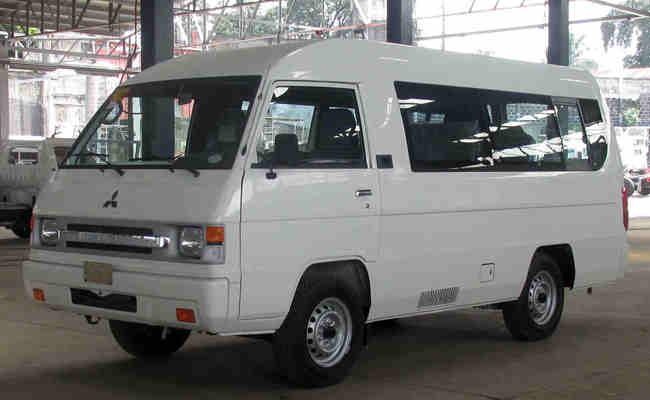
So now we look at the stories Mitsubishi L300, a van sporting its characteristic “box-type” design language—squared off and angular lines, square headlights and square grille.  Inside, it sports a 15 inch Bakelite steering wheel with a 5 speed transmission mounted on the steering column.  A tried and tested design that has survived unchanged since 1991.  It is a veritable dinosaur in the car scene.

2006 Mitsubishi L300 FB
L300 interior

Madalas makita ito sa pelikula noong 90s -BG
Posted by Kami ang Batang 90s on Thursday, 10 September 2015
The iconic L300 van


The original consumer version of the L300 had a van body style.  A body style made iconic by the numerous Filipino action movies using this type of vehicle as transportation for baddies and kidnap scenes as seen in the above meme.

This body style was eventually phased out and replaced by newer designs such as the Space Gear pictured below.


MITSUBISHI SPACE GEAR 2000mdl 4x4 GREEN FIELD EDITION
(Source: adpost.ph)

Since then the Mitsubishi L300 has been sold continuously in the Philippines as a cab and rolling chassis under the name L300 FB Exceed chassis.  Truck body builders such as Centro and Almazora would then build bodies for it.  One would commonly see pick up, container truck and passenger variants of it, among others.  
L300 CHASSIS CAB ? Las Piñas City
Optional Truck Bodies

But the van configuration has since passed into memory.

Until…

Mitsubishi L300 XV Mikrobus


Yes, that’s right! Centro, an enterprising truck body builder, decided to breathe new life into this classic and timeless design.  

According to its president:  

We saw the upsurge in the nationwide demand in the shuttle segment of the mass transport industry, and realized that most of the reliable Japanese shuttle models have only 15 seats or less yet have a price tag of over P1 million.  We therefore saw the demand for a minibus converted from a Japanese chassis cab with over 15 seats yet costs less than P1 million. Our answer is the L300 XV with 17 seats and at an introductory price of only P898,000.

Good news indeed and I can see this being bought by some consumers who aren’t willing to part with upwards of a million pesos on a passenger van for home use.


Related:


Sunday, December 20, 2015

HOPI HEIRLOOM CORN:

THEORETICAL CROSSES WITH PHILIPPINE MAIZE STRAINS

Food security is something that should concern us as a people. Dependence on rice, without the corresponding ability to grow a sufficient amount of it, will render us vulnerable to international rice price increases and availability.  

Rice is notoriously unsuited to our geography—there simply aren’t enough, wide open flood plains.  Where they do exist, irrigation is inadequate. With our growing population, it is simply too difficult to support it using rice alone.  It is thus in our interest if we found a crop that we could use to partially replace rice.

How about corn?

The Philippines is self-sufficient in corn (zea Mays). We grow lots of it and it is the second most important crop here next to rice.

Corn here is generally used to make animal feed. Very little of it goes into our diet compared to rice. * I estimate that if more corn were used for human consumption (or if it would be used to replace rice altogether), then it’s very possible that we won't need to import rice from other countries.


Corn Fit for Human Consumption
Part of actually getting people to eat corn directly, rather than to grow it as an animal feed is to actually have varieties of corn fit for human consumption—this is where Hopi corn comes in!

This is also a flour corn, which means that this is very suitable for making corn flour or cornmeal.  It is also very good for gritting.  The corn we normally grow for feed is flint corn, which as the name implies is very hard and is simply not suitable for human consumption.

Desirable traits
The Hopi Indian tribe has been growing a specific variety of Maize (Zea mays) in the Arizona desert for thousands of years. Their agricultural techniques are very well suited to the dry and hot desert (with its occasional flashfloods!) climate of the American Southwest.


Hopi Corn
(Source: azcentral.com)

Years of selective breeding has created a corn variety which can withstand heat and flashfloods.  It grows a very deep root system and its seeds are necessarily rich in energy.  The Hopi grow their corn by burying the seed 1 feet deep in the arid soil.  The video below shows how the Hopi cultivate their corn.

(Source: this video was originally found in Encarta encyclopedia)

Amazingly, the plant is still able to sprout in spite of being buried so deep.  These adaptations give this strain a great many advantages specifically:  

  1. Because the seed was buried so deeply, the roots have access to moisture locked deep within the subsoil.

  1. Because the root system is buried so deep, the plant can withstand harsh winds and flashfloods that happen in the desert.

  1. The roots do not compete for nutrients with other plants.

These are highly desirable traits which if crossed with Philippine varieties of corn could very well produce a very well-adapted hybrid.  Specifically, this can potentially be the basis of a maintenance-free strain of corn—one that doesn’t need irrigation or weeding and can withstand typhoons!

This hybrid will also fit in with the corn culture in the Philippines.  Philippine corn often grow corn during the dry season in a dried up rice paddy—the corn is harvested before the rains come and after which, rice will be replanted. Hopi corn will suit this kind of crop rotation superbly. The corn is planted deep in the soil, so the roots are getting their nutrients from the subsoil. This means that the corn will not compete for nutrients with the next crop of rice which has shallow root systems and thus get their nutrients from the topsoil. This way, the rice paddy's topsoil gets a full season's rest before the next crop.


El Niño
It goes without saying that the world is due for a massive drought caused by this weather anomaly called El Niño.  A corn variety such as this will be able to thrive in the changing climate that we are experiencing today.

Conclusion
I understand that rice is culturally ingrained in the Filipino psyche—we all understand that a meal isn’t a meal if there isn’t rice on the table—but sometimes, solving problems such as food security may require some dietary changes.  Corn, as a rice replacement holds some potential, indeed, the Philippines is already more successful in self-sufficiency when it comes to corn than with rice.  The introduction of corn which is fit for human consumption, and which contain traits that would suit it to adverse climates can go a long way to solving our food security problems.  To that end, I strongly recommend conducting hybridization experiments with Hopi heirloom corn.

-----
*Filipinos do have some tasty corn-based treats like roasted corn, binatog and a local favorite is baye-baye.  I hear Boholanos also mix corn into their rice as a filler.